
The global housing debate is usually framed as a problem of numbers. Nearly 3 billion people live in inadequate housing, more than 1.1 billion of them in informal settlements, and over 300 million experience homelessness [1]. The thirteenth World Urban Forum, held in Baku in May 2026, gave these figures renewed prominence, and one of its sessions went further, treating housing as a determinant of physical and mental health rather than a matter of supply alone [2]. Consequently, that shift exposes a conceptual gap. Policy speaks fluently about housing quantity, yet the term on which health outcomes depend, housing quality, remains loosely defined and inconsistently measured.
This essay argues that housing quality is best understood not as a property of buildings but as a set of conditions that a dwelling and its surroundings create for the people who live in them. Read through recent evidence, five of those conditions carry the greatest weight for health: structural safety, indoor air, thermal comfort, adequate living space and proximity to open space. Moreover, each is distinct, each is measurable, and each is routinely conflated with the others.
From adequacy to habitability
The idea that housing must be more than shelter has a long pedigree in international law. In 1991 the UN Committee on Economic, Social and Cultural Rights defined adequate housing through seven elements, among them habitability, meaning adequate space and protection from cold, damp, heat and other threats to health, alongside security of tenure, affordability, accessibility, location and access to services [3]. Habitability, in this formulation, is therefore a relation between a dwelling and the bodies it houses.
The World Health Organization’s Housing and Health Guidelines translate that principle into evidence-based standards. Drawing on commissioned systematic reviews, they address household crowding, low and high indoor temperatures, injury hazards and accessibility, and they consolidate existing WHO guidance on water, air quality, noise, asbestos, lead, tobacco smoke and radon [4]. Two of their recommendations are rated strong: that strategies be adopted to prevent and reduce crowding, and that indoor temperatures be kept high enough to protect health, with 18 °C proposed for temperate and colder climates [5]. In this way, the guidelines measure housing quality by exposure and outcome, not by construction materials or market value. As a result, a structurally sound apartment may still be a poor-quality home if it is crowded, overheated or poorly ventilated.
Indoor air as a dimension of housing quality
Indoor air is the dimension of housing quality with the clearest mortality burden. Household air pollution from cooking with solid fuels and kerosene was associated with an estimated 2.9 million deaths in 2021, including more than 309,000 children under five [6]. Yet the problem does not end with the transition to cleaner fuels. A 2025 scholarly review found that indoor PM2.5 rarely meets WHO guideline values and is driven largely by indoor sources such as smoking, heating, cooking, cleaning and personal care, with low incomes and poor-quality housing compounding exposure [7]. Similarly, in India, recent work on urban households has examined how ventilation practices during cooking shape residents’ exposure to fine particles [8].
The evidence on engineered solutions is instructive precisely because it is uneven. Positive pressure ventilation reduced indoor PM2.5 by between 38 and 62 per cent in a sample of New Zealand homes [9], whereas whole-house mechanical ventilation in 51 recently built homes in the humid south-eastern United States lowered carbon dioxide and radon but produced no discernible reduction in PM2.5 or formaldehyde [10]. Indoor air quality, in short, is a function of source control, building envelope and occupant behaviour together; no single technology secures it.
Housing quality, damp and psychological wellbeing
The health consequences of poor housing extend beyond the respiratory system. A 2024 synthesis of 40 systematic reviews found low-to-moderate certainty evidence associating damp, mould, inadequate warmth and poor indoor air with worse respiratory and cardiovascular outcomes, and some evidence linking housing precarity and overcrowding with poorer mental health [11]. Furthermore, recent qualitative research deepens that finding. A 2026 study of social housing tenants in Greater Manchester, combining 582 survey responses with 41 in-depth interviews, documented substantial effects of damp and mould on both physical and mental health, concentrated among the most vulnerable households [12]. Housing quality is therefore experienced, not merely measured: it shapes sleep, stress and the sense of control residents have over their own lives.
Density and crowding: a persistent conflation
Few distinctions in urban policy are as consequential, or as frequently blurred, as that between density and crowding. Density describes the number of people per unit of land; crowding describes the number of people per room. Crucially, their health implications diverge. A study of Tehran during the COVID-19 pandemic concluded that density alone could not be considered a risk factor for infection, and that overcrowding, which may occur even in low-density districts, was the operative driver [13]. Analysis of United States housing data points the same way: Manhattan’s neighbourhoods, the densest in the country, were only marginally more crowded than the national average, and crowding tracked housing unaffordability more closely than density [14].
The distinction has direct implications for how housing quality is regulated. On the one hand, compact neighbourhoods can sustain public transport, services and social life, whereas crowded dwellings undermine health irrespective of neighbourhood form. It is telling that the WHO’s strong recommendation concerns crowding within the home, not density across the city [5]. Policies that restrict density in the name of health may therefore address the wrong variable, and may even worsen crowding by constraining supply.
Open space and housing quality beyond the dwelling
The boundary of housing quality does not coincide with the boundary of the dwelling. The WHO recommends that every resident live within 300 metres, in straight-line distance, of a green space of at least 0.5 hectares [15]. However, measured against that benchmark, a study of more than 1,000 European cities published in The Lancet Planetary Health found that over 60 per cent of residents lacked adequate access, and estimated that compliance could prevent roughly 43,000 deaths a year [16]. The 3-30-300 heuristic proposed by urban foresters, three trees visible from each home, 30 per cent canopy cover in each neighbourhood and a park within 300 metres, offers a more operational version of the same principle [17].
For dense cities, open space is thus not an amenity but a condition of habitability. Compact dwellings can support good health where they are embedded in a network of courtyards, parks and shaded streets; without that network, the same floor area becomes a source of strain. In this sense, density and open space are complements, not trade-offs.
| Dimension of quality | What it captures | Principal health association | Typical blind spot in policy |
|---|---|---|---|
| Structural safety | Soundness, injury hazards | Falls and injuries | Treated as the whole of quality |
| Indoor air | Fuels, ventilation, damp and mould | Respiratory and cardiovascular disease | Seldom monitored inside homes |
| Thermal comfort | Protection from cold and heat | Heat illness, cardiovascular strain | Underweighted in hot climates |
| Living space | Persons per room | Infection, stress, mental health | Conflated with neighbourhood density |
| Open space | Proximity to green and public space | Mortality, mental wellbeing | Regarded as amenity, not infrastructure |
Towards a habitability-based definition of housing quality
Taken together, the evidence supports a definition of housing quality grounded in habitability rather than construction. A dwelling of good quality maintains safe indoor temperatures, supplies clean air, remains dry, provides adequate space per person and connects its occupants to open space within walking distance. Importantly, these conditions are separable, and a dwelling may perform well on one and poorly on another, as a structurally sound tower with inadequate ventilation, or a spacious suburban house remote from any park, can illustrate.
The implication for research and practice is that housing quality should be assessed as a profile rather than a single score, and that its most consequential dimensions lie squarely within the reach of planners, architects and housing authorities. As the global agenda turns towards housing after Baku [2], the measure of progress will be not only how many dwellings are delivered, but how far each sustains the health of those who live in it.
Related on Urban Frontier Insights: Whose Square Is It? and Who Will Care for Us?
Connect with the author, Asesh Sarkar, on LinkedIn, and follow Urban Frontier Insights on LinkedIn.
References
Housing standards and rights
1. World Urban Forum 13. (2026). Briefing for international media held in Nairobi. wuf13.az
2. United Nations. (2026). Pulse of healthy homes [WUF13 session description]. transcripts.un.org
3. UN Committee on Economic, Social and Cultural Rights. (1991). General Comment No. 4: The right to adequate housing (Art. 11(1) of the Covenant) (E/1992/23).
4. World Health Organization. (2018). WHO housing and health guidelines. who.int
5. World Health Organization. (2018). Recommendations of the WHO housing and health guidelines [Table 1]. NCBI Bookshelf. ncbi.nlm.nih.gov
Indoor environment and health
6. World Health Organization. (n.d.). Household air pollution and health [Fact sheet]. who.int
7. Indoor air quality and particulate matter. (2025). In New perspectives in indoor air quality. Ben-Gurion University research portal. cris.bgu.ac.il
8. Shanmuga Sundaram, I., Gandhimathi, & Sri Pranap. (2025). Indoor air pollution from residential cooking: Assessing ventilation behaviors, PM2.5 exposure, and health implications in urban Indian homes. Global NEST Journal, 27(10), 1–16. https://doi.org/10.30955/gnj.07834
9. Positive pressure ventilation systems and indoor air quality: PM2.5 outcomes in residential buildings. (2026). Building and Environment (accepted manuscript). Auckland University of Technology repository. openrepository.aut.ac.nz
10. Lawrence Berkeley National Laboratory. (2025). Mechanical ventilation and indoor air quality in recently constructed homes in the humid climate of the Southeast U.S. Indoor Environments. https://doi.org/10.1016/j.indenv.2025.100121
11. NIHR ARC Greater Manchester & University of Manchester. (2024). What is the health impact of poor housing? [Rapid evidence synthesis]. healthierfutures.manchester.ac.uk
12. Sherriff, G., Kelly, S., Martin, P., & Pink, J. (2026, 1 June). Mould and damp in social housing: Insights from tenant research in Greater Manchester. HSTalks. hstalks.com
Density and open space
13. University of Tehran. (2021, 17 April). Residents in packed cities aren’t more likely to get COVID-19, study says [on Sharifi et al., Sustainable Cities and Society]. international.ut.ac.ir
14. National Multifamily Housing Council. (2020). How much is overcrowding a factor in COVID-19 risk? nmhc.org
15. ISGlobal. (2021). ISGlobal publishes ranking of European cities with highest mortality due to lack of green space. isglobal.org
16. Bloomberg CityLab. (2021, 17 November). Europe’s greenest cities might not be the ones you think [on Barboza et al., The Lancet Planetary Health]. bloomberg.com
17. The Conversation. (2021). More parks and waterways in cities could prevent premature deaths, study finds. theconversation.com
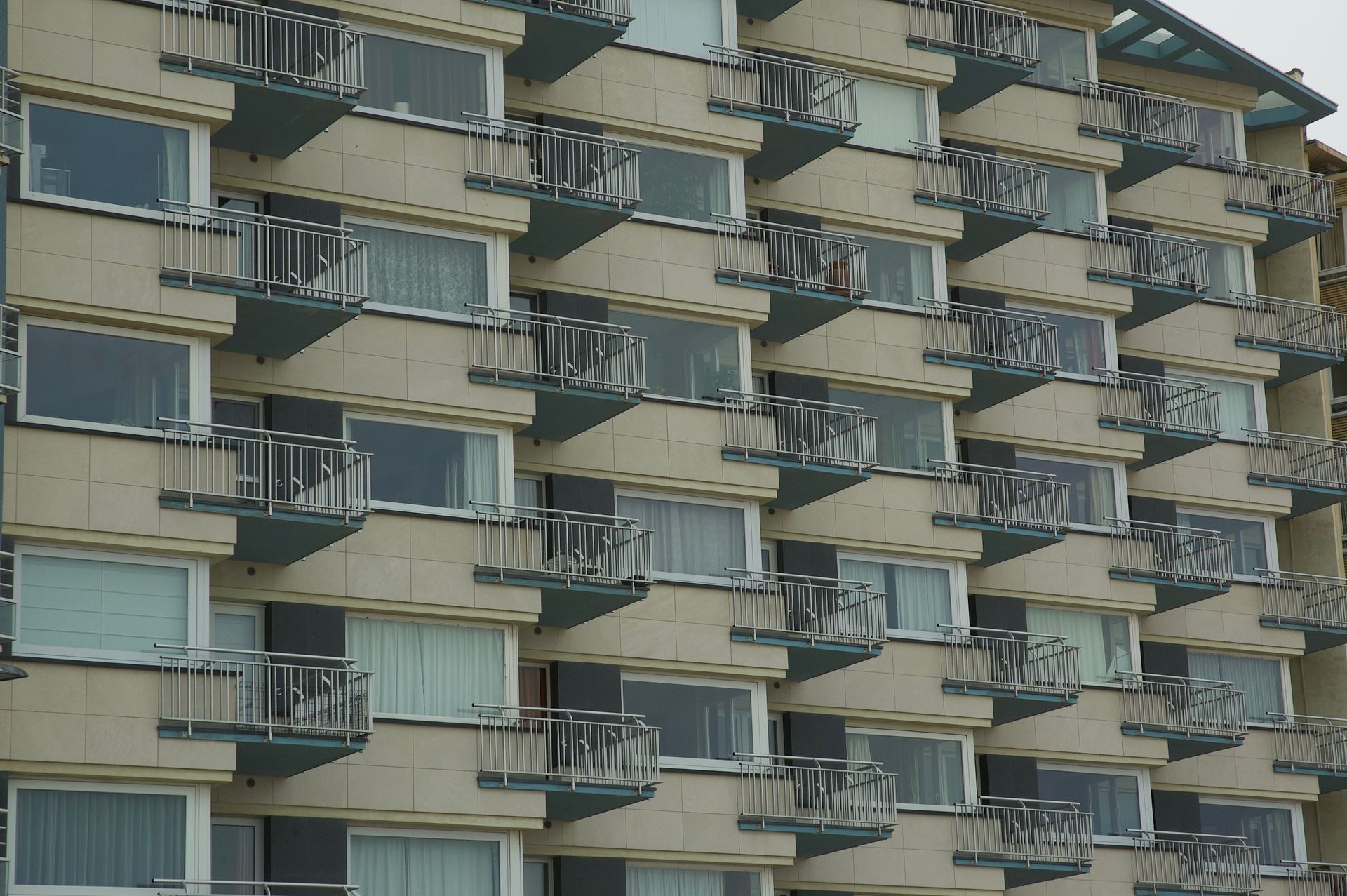
Cover image: Exterior of a residential block in a city. Photo by Emmanuel Codden on Pexels.
Write for UFI
Have a story about cities? We publish articles and photo essays from researchers, practitioners and photographers.
Pitch us at contact@urbanfrontierinsights.com