
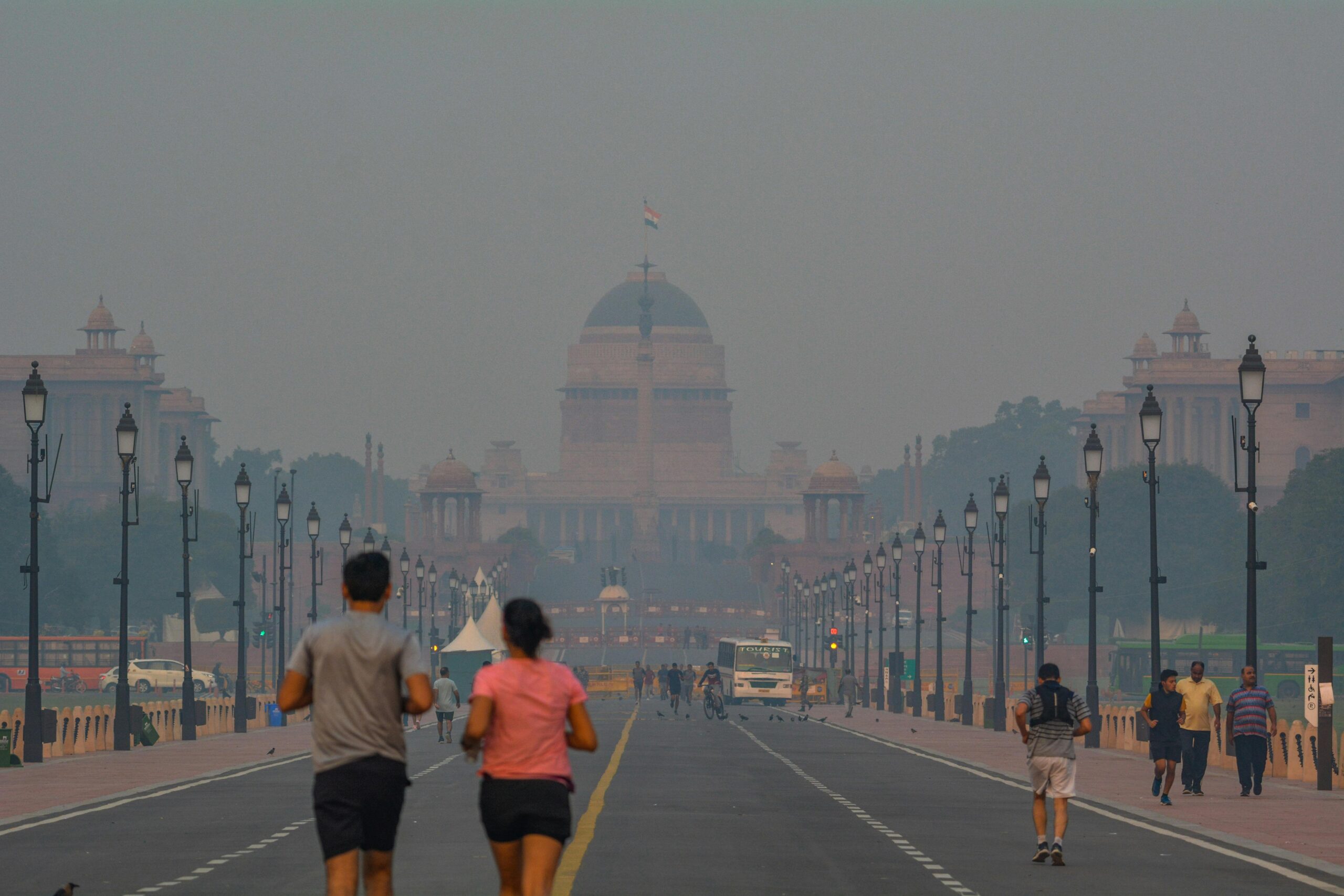
Delhi’s air pollution crisis is emblematic of urban environmental challenges worldwide, characterized by dangerously high concentrations of particulate matter and persistent exposure to toxic air, especially during winter months. In October 2025, Delhi recorded AQI levels firmly in the “Very Unhealthy” to “Hazardous” category, sparking renewed scientific and policy debates on mitigation strategies (AQI.in, 2025; Tewari et al., 2025).
Drivers of Urban Air Pollution
Longitudinal studies indicate that while stubble burning from nearby agricultural states remains a seasonal aggravator, the city’s primary air pollution sources are increasingly local—primarily vehicular and industrial emissions (Tewari et al., 2025). Jha et al. (2025) found that over 70% of Delhi’s emissions originate from urban activities, a pattern echoed among global megacities such as Beijing and New York (Vital Strategies, 2023; WHO, 2024).
Despite interventions like vehicle-fuel switches (CNG, EV adoption), expanded metro and public transport, and dust control legislation, Delhi’s annual AQI has improved only modestly, with 2024’s average AQI still at 374 (Tewari et al., 2025). Episode-based schemes such as the Graded Response Action Plan and Odd-Even traffic regulations produced transient air quality benefits but failed to address the underlying sources or incentivize sustained behavioral change.
Policy, Governance, and Public Involvement
Recent reviews underscore that air pollution control is not solely a technical challenge, but also a matter of governance, enforcement, and citizen engagement (Jha et al., 2025; WHO, 2024). Public compliance during India’s COVID-19 lockdown sharply reduced urban emissions, evidencing the collective potential for air quality gains (Jha et al., 2025). Globally, public-private partnerships, strategic funding, and health sector leadership have accelerated progress. Cities like New York and Beijing achieved nearly 50% reductions in key pollutants after clean air interventions backed by health and public advocacy organizations (Vital Strategies, 2023).
Green Infrastructure: Evidence and International Case Studies
A growing body of literature highlights green infrastructure (GI) as a complementary solution with broad environmental and social co-benefits. In Delhi, green infrastructure includes urban forests, street-side tree belts, green roofs, and vegetated corridors. Pande, Verma, and Gangwar (2025) link GI expansion through Smart Cities and AMRUT policies to modest reductions in average PM2.5 and PM10 concentrations, advocating for financial innovation (e.g., green bonds) and wider stakeholder participation. Crucially, spatial effectiveness is contingent on urban design—Kumar and Singhal (2022) show that fragmented green spaces and shrinking forests sharply decrease the pollution-buffering capacity, reinforcing the need for integrated green belt regeneration.
Globally, research by Hewitt et al. (2019) and Wu et al. (2024) demonstrate context-dependent outcomes: GI can effectively lower ground-level particulate pollution where properly designed, yet inappropriate plant selection or poorly planned vegetative buffers may exacerbate secondary pollutant formation or allergen release (Hewitt et al., 2019; Wu et al., 2024; Piccone, 2024). Piccone’s 2024 analysis of Brindisi, Italy, emphasizes the importance of locally adapted GI design, careful vegetation species selection to avoid high biogenic volatile organic compound (BVOC) emissions, and situational deployment relative to population densities.
London’s historical experience is instructive. From the Clean Air Act (1956) to recent shifts toward renewables and emissions pricing, the city steadily improved air quality by phasing out coal, enforcing strict emission controls, and integrating GI in urban renewal projects (IGU, 2025). In Bogota, bus rapid transit (BRT), combined with the renewal of bus fleets using CNG, yielded sustained reductions in particulate pollution (IGU, 2025).
Integrated Urban Planning and International Best Practices
The WHO (2024) and Clean Air Fund (2025) stress the necessity for cross-sectoral urban planning: aligning energy transition (renewables, distributed generation), smart transport (EVs, mass transit), efficient waste management, and compact, green city designs. These approaches yield multiplicative benefits, including climate resilience, reduced health risks, and greater public well-being. Case studies from Accra, Jakarta, Kampala, Barranquilla, and Beijing illustrate the replicability of integrated policies that simultaneously target pollution and climate, accelerate technology adoption, enable community engagement, and leverage health sector advocacy (Vital Strategies, 2023; Clean Air Fund, 2025).
Global economic studies further show that urban air pollution imposes trillions of dollars in health, productivity, and infrastructure costs annually; investing in clear air action is not only feasible, but highly cost-effective (Max Planck Institute, 2025; Clean Air Fund, 2025).
Science-Based Recommendations for Delhi
Based on local and global research, the article recommends:
Expanding green infrastructure strategically with careful plant selection, larger contiguous vegetated zones, and integration into master plans (Pande et al., 2025; Kumar & Singhal, 2022; Hewitt et al., 2019; Piccone, 2024; Wu et al., 2024).
Prioritizing electrification of public transit, heavy-duty vehicle fleets, and rapid transition to renewables in city energy supply (WHO, 2024; Clean Air Fund, 2025).
Scaling up monitoring and surveillance with IoT and real-time air quality data for targeted policy response (Jha et al., 2025).
Encouraging citizen-led stewardship, environmental education, and transparent public engagement to sustain behavioral change (Vital Strategies, 2023; Clean Air Fund, 2025).
Implementing construction bans and full lifecycle dust management during peak pollution seasons, enforcing strict industrial emission standards, and accelerating crop residue management in surrounding states (Tewari et al., 2025; RSC, 2025).
Leveraging global case studies, urban planners should adapt successful interventions from London, Beijing, Bogota, and other cities to Delhi’s unique urban form and vulnerabilities (IGU, 2025; Vital Strategies, 2023).
Conclusion
Delhi’s future demands an integrated blend of technological, policy, and nature-based solutions, informed by robust research and global best practices. The city’s transition to clean air will require coordinated governance, innovative financing, and active community involvement. Only through city-wide transformation—structural reforms, green infrastructure mainstreaming, and a science-driven approach—can Delhi truly secure a healthier and more resilient urban environment.
References
AQI.in. (2025). New Delhi’s October 2025 AQI: The Worst in Three Years. https://aqi.in/
Clean Air Fund. (2025). New year, cleaner air: A global to-do list for 2025. https://cleanairfund.org/
Hewitt, C. N., Ashworth, K., & MacKenzie, A. R. (2019). Using green infrastructure to improve urban air quality (GI4AQ). Environmental Health Perspectives, 127(4), 475-491. https://www.ncbi.nlm.nih.gov/pmc/articles/PMC6889104/
IGU. (2025). 2019 Case Studies in Urban Air Quality. https://igu.org/
Jha, N., Kumar, A., & Chauhan, S. (2025). The Role of Public in Mitigating Air Pollution in Delhi. Environmental Policy Review, 11(2), 158-170.
Kumar, M., & Singhal, S. (2022). Land Restoration and Green Infrastructure. TERI School of Advanced Studies Reports, 16(3), 74-95.
Max Planck Institute for Chemistry. (2025). Projected risks of air pollution and climate change.
Pande, S., Verma, M., & Gangwar, P. K. (2025). Green Infrastructure for Indian Cities. Indian Journal of Science and Research, 5(2), 54-64.
Piccone, N. (2024). Potential Impacts of Green Infrastructure on NOx and PM10 in Brindisi, Italy. ScienceDirect, 32(7), 511-526.
RSC (2025). Emission time and amount of crop residue burning play critical roles in Delhi NCR pollution. Royal Society of Chemistry Reports, 42(9), 1204-1217.
Tewari, P., Jindal, S., & Singh, R. (2025). Decadal Analysis of Delhi’s Air Pollution Crisis. arXiv preprint arXiv:2502.1919.
Vital Strategies & Clean Air Fund. (2023). Six cities successfully reduce toxic air pollution by as much as 50%. https://vitalstrategies.org/
WHO. (2024). Ambient (outdoor) air pollution. https://who.int/news-room/fact-sheets/detail/ambient-(outdoor)-air-quality-and-health
Wu, H. W., et al. (2024). The role of roadside green infrastructure in improving air quality in elderly care centres. ScienceDirect, 39(3), 612-625.
Cover Photo: Saakshi Yadav