
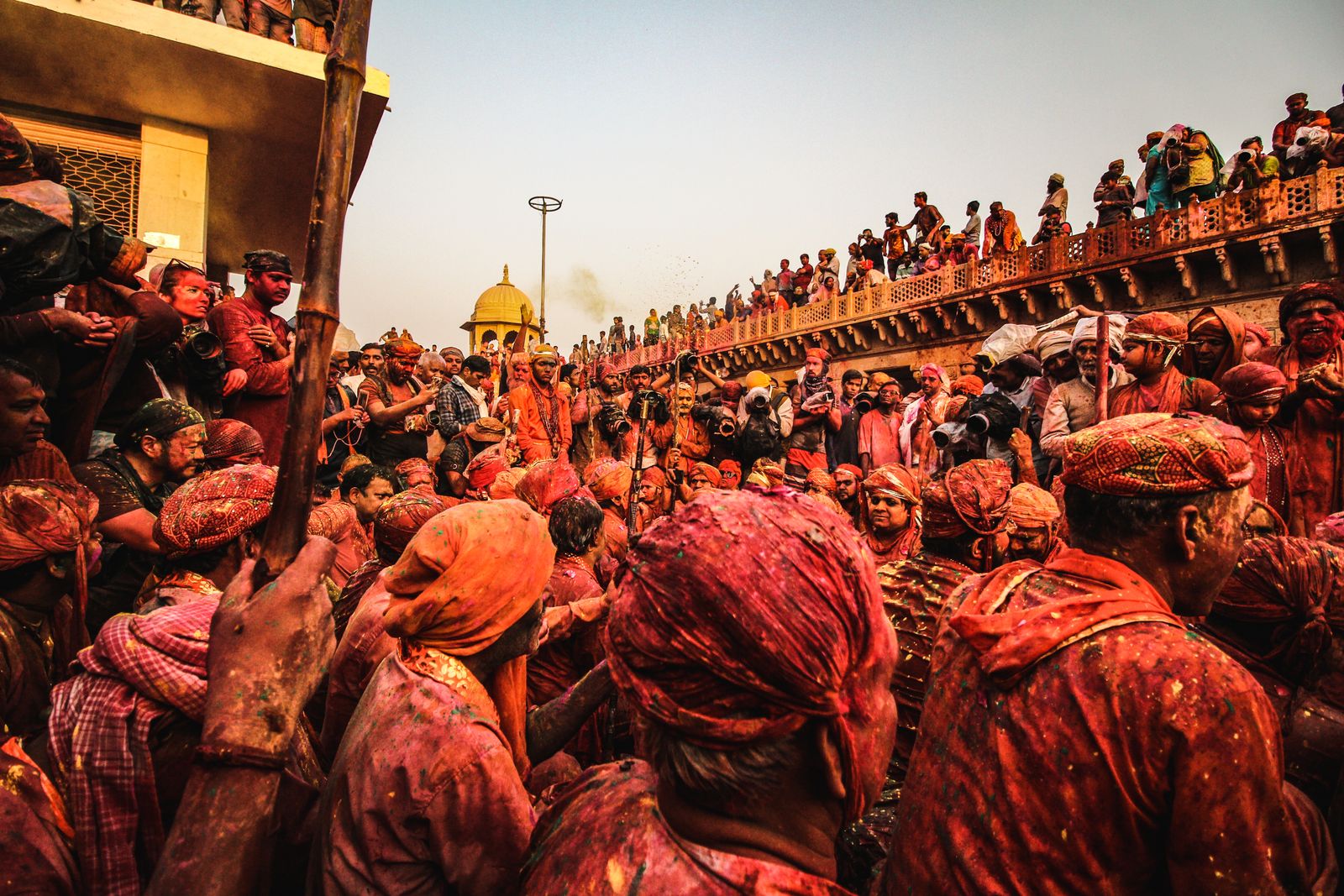
On a Sunday in Bogotá, 121 kilometres of roads close to motor vehicles and somewhere between 600,000 and 1.4 million people walk, cycle and dance through the city [1]. In Barcelona, superblocks hand interior streets back to neighbours [2]. In Kolkata, Durga Puja turns parks and lanes into open-air galleries visited by crowds of every background [3]. And since 2013, Gurugram’s Raahgiri Day has inspired car-free street festivals in more than 50 cities [4]. These are more than events. They express what might be called a city’s sense of celebration: the shared feeling of joy, occasion and belonging that arises when people gather in public. It depends on space, it shapes social life and culture, and it is too important to be left to chance in our master plans.
Public space: the stage of celebration
Celebration needs a stage. Jan Gehl distinguished between necessary activities, which happen in almost any setting, and optional and social activities — lingering, meeting, celebrating — which flourish only where the quality of public space invites them [5]. Copenhagen tested the idea at city scale: after its main street, Strøget, was pedestrianised in 1962, decades of observation recorded public life growing as space for people grew [6]. Bogotá’s Ciclovía began in 1974 as a protest on two streets and became a weekly institution now studied as a mass-recreation programme with public-health potential [1][7]. Reclaiming streets also pays measurable dividends: a health impact assessment of 503 potential superblocks in Barcelona estimated that they could prevent nearly 700 premature deaths a year [2].
Big occasions grow from everyday rituals. Ray Oldenburg called the informal gathering places beyond home and work — the café, the tea stall, the barbershop — “third places”, the foundations of community life [8]. A city that sustains them has a sense of celebration between festivals, not just during them.
Why it matters: social connection and culture
The sociologist Émile Durkheim described the charged feeling of a gathered crowd as “collective effervescence”, a moment of being lifted into something larger than oneself [9]. Psychologists now find that it occurs not only in ritual but at concerts, matches and community events, and that it is linked to positive emotion, meaning in life and social connection [10]. Following pilgrims at the Magh Mela in Prayagraj alongside a comparison group, Tewari and colleagues found that participants reported better well-being a month after the gathering [11].
This is a public-health matter. A meta-analysis of 148 studies found that people with stronger social relationships had a 50% greater likelihood of survival [12], and the WHO Commission on Social Connection estimates that one in six people worldwide is affected by loneliness, linked to more than 871,000 deaths a year [13]. Celebration is also how cities carry culture: festivals transmit heritage, give minority communities visibility and let plural identities share the same street. United Cities and Local Governments has argued that culture should be treated as the fourth pillar of sustainable development, alongside the economy, social inclusion and the environment [14].
Research from Indian cities points the same way. Sarkar and Pujara’s conceptual framework identifies community centres, places of worship and diverse, inclusive public spaces as sources of social support and collective identity that bear on mental well-being [15]. Their wider programme has examined how residents of Delhi perceive their urban environment in relation to mental well-being [16], how residents, planners and other stakeholders perceive 49 physical and 12 social environment indicators [17], and how the quality of and access to green spaces relate to loneliness in India [18].
What planners and designers need to do
Yet master plans and city development plans rarely treat celebration as a function of the city. UN-Habitat recommends that 45–50% of urban land be given to streets and public space, including 15–20% as open public space, and SDG target 11.7 calls for universal access to safe, inclusive public spaces by 2030 [19]. India’s URDPFI guidelines suggest 10–12 m² of open space per person; Mumbai offers about 1.24 m² of accessible open space per resident [20]. Five shifts would help.
Plan celebration as a land use. Designate and protect civic grounds, maidans, plazas and festival routes at ward and city scale, designed for daily use as well as peak occasions.
Design streets as flexible stages. Build in power points, water, drainage, shade anchors and removable bollards, and write open-streets programmes such as Ciclovía and Raahgiri into mobility plans rather than leaving them to goodwill.
Plan for time, not only space. Map the festival calendar into the plan: crowd capacity, transit, sanitation, waste and noise management for recurring peak events.
Design for plurality and inclusion. A city of many festivals needs genuinely shared spaces that are lit, safe for women and children, step-free, shaded and equipped with toilets, so that the mixing UNESCO recognised in Kolkata becomes ordinary [3].
Measure what matters. Include social and cultural indicators in plan monitoring. Tools such as the urban environment assessment framework for mental well-being developed for Indian cities can make these qualities measurable [21].
Conclusion
A city’s sense of celebration is as real a measure of its health as its air quality or green cover. In an age of loneliness, planning streets, squares and parks that can hold collective joy is not frivolous; it is infrastructure for social connection and culture, and it belongs in every master plan.
References
1. Asian Development Bank. “Car-Free Days Can Give Big Cities Room to Breathe.” Development Asia (case study). development.asia
2. Mueller, N., Rojas-Rueda, D., Khreis, H., Cirach, M., Andrés, D., Ballester, J., et al. (2020). Changing the urban design of cities for health: The superblock model. Environment International, 134, 105132.
3. UNESCO. (2021). “Durga Puja in Kolkata.” Representative List of the Intangible Cultural Heritage of Humanity, Decision 16.COM 8.b.15. ich.unesco.org
4. Bhatt, A. (2018, July 9). How a small experiment in Delhi’s suburbs sparked a national car-free movement. WRI India. wri-india.org
5. Gehl, J. (2011 [1971]). Life Between Buildings: Using Public Space. Washington, DC: Island Press.
6. Gehl, J., & Gemzøe, L. (1996). Public Spaces, Public Life. Copenhagen: Danish Architectural Press.
7. Sarmiento, O., Torres, A., Jacoby, E., Pratt, M., Schmid, T. L., & Stierling, G. (2010). The Ciclovía-Recreativa: A mass-recreational program with public health potential. Journal of Physical Activity and Health, 7(Suppl. 2), S163–S180.
8. Oldenburg, R. (1989). The Great Good Place. New York: Paragon House.
9. Durkheim, É. (1995 [1912]). The Elementary Forms of Religious Life (K. E. Fields, Trans.). New York: Free Press.
10. Gabriel, S., Naidu, E., Paravati, E., Morrison, C. D., & Gainey, K. (2020). Creating the sacred from the profane: Collective effervescence and everyday activities. The Journal of Positive Psychology, 15(1), 129–154. doi.org/10.1080/17439760.2019.1689412
11. Tewari, S., Khan, S., Hopkins, N., Srinivasan, N., & Reicher, S. (2012). Participation in mass gatherings can benefit well-being: Longitudinal and control data from a North Indian Hindu pilgrimage event. PLoS ONE, 7(10), e47291. doi.org/10.1371/journal.pone.0047291
12. Holt-Lunstad, J., Smith, T. B., & Layton, J. B. (2010). Social relationships and mortality risk: A meta-analytic review. PLoS Medicine, 7(7), e1000316. doi.org/10.1371/journal.pmed.1000316
13. World Health Organization. (2025). From Loneliness to Social Connection: Charting a Path to Healthier Societies. Report of the WHO Commission on Social Connection. Geneva: WHO. who.int
14. United Cities and Local Governments. (2010). Culture: Fourth Pillar of Sustainable Development. Policy statement approved in Mexico City, 17 November 2010. agenda21culture.net
15. Sarkar, A., & Pujara, T. (2025). A conceptual framework for mapping urban environment indicators and mental well-being. Discover Cities, 2(1), 119. doi.org/10.1007/s44327-025-00166-z
16. Sarkar, A., & Pujara, T. (2025). Exploring the link between perceived urban environments and mental well-being: A case study of Delhi, India. Cities & Health, 9(2), 226–247. doi.org/10.1080/23748834.2025.2457847
17. Sarkar, A., & Pujara, T. (2025). Perceptions of urban environment indicators associated with mental well-being: A stakeholder investigation. Cities & Health, 9(2), 273–297. doi.org/10.1080/23748834.2025.2480480
18. Sarkar, A., Gemmell, E., P S, S., Anand, S., Bhattacharya, A. A., & Pujara, T. (2026). Perceived quality and access to urban green spaces and loneliness in India. Cities & Health. Advance online publication. doi.org/10.1080/23748834.2026.2686415
19. UN-Habitat. (2018). SDG Indicator 11.7.1 Training Module: Public Space. Nairobi: United Nations Human Settlements Programme. unhabitat.org
20. Udas-Mankikar, S. (2020). Formulating Open Space Policies for India’s Cities: The Case of Mumbai (ORF Occasional Paper No. 241). New Delhi: Observer Research Foundation. orfonline.org
21. Sarkar, A., & Pujara, T. (2024). Development of an urban environment assessment framework for mental well-being in India using nominal group technique and rank order centroid method. Cities & Health, 9(1), 90–111. doi.org/10.1080/23748834.2024.2436708
Cover image: Holi celebrations in India. Photo by Yogendra Singh on Pexels.
Write for UFI
Have a story about cities? We publish articles and photo essays from researchers, practitioners and photographers.
Pitch us at contact@urbanfrontierinsights.com