
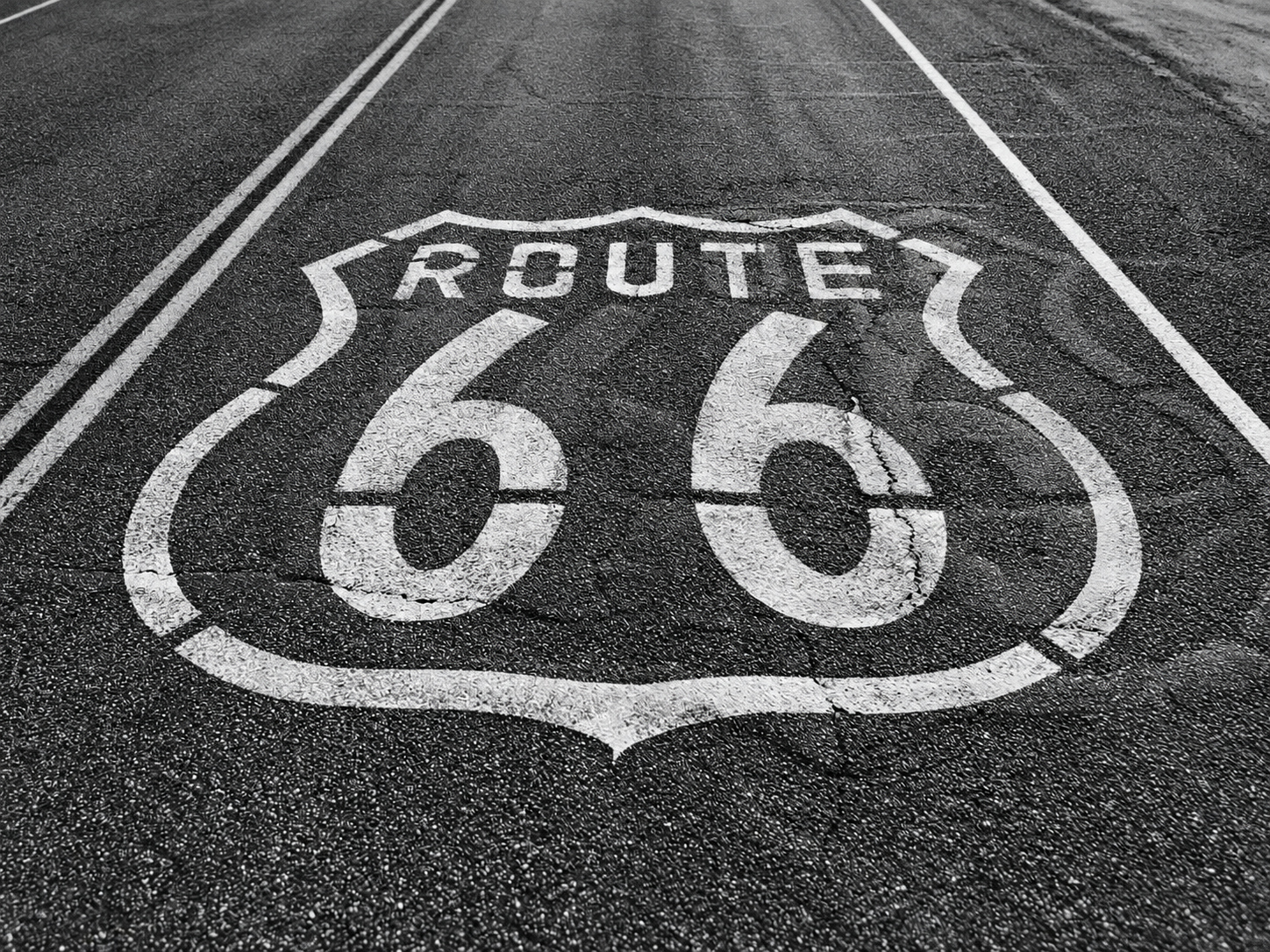
Cover: The Road as Emblem. Route 66, United States · 2018. Photo: Neil Wildin.
Roads, relics and the spectacle of the everyday.
A photographic essay from journeys across the United States, moving from desert highways and roadside objects to preserved history, popular culture and the illuminated spectacle of Las Vegas.
A photographic essay by Neil Wildin
The Route 66 emblem is painted directly onto the road. Its white lines have begun to break apart, and the asphalt shows through the lettering. It is a familiar sign, although seeing it in this condition brings it back to something quite ordinary. It is a road marking, exposed to traffic, weather and whatever repairs the surface may eventually require. Yet people travel considerable distances to photograph it. The number has acquired a significance that extends far beyond its original purpose, becoming a shorthand for journeys through an America that many people know principally through films, television and photographs.
I had encountered that version of America long before making these photographs in 2017 and 2018. It would have been difficult not to. Certain images have circulated so widely that arriving in the country can feel, at moments, like recognising somewhere already visited. The experience is peculiar because recognition normally follows acquaintance. Here it can come first. The road, the flag, the yellow school bus and the desert landscape all carry associations that may have very little to do with the particular place in front of the camera. I was interested in what remained of those places once the familiar image had been recognised.
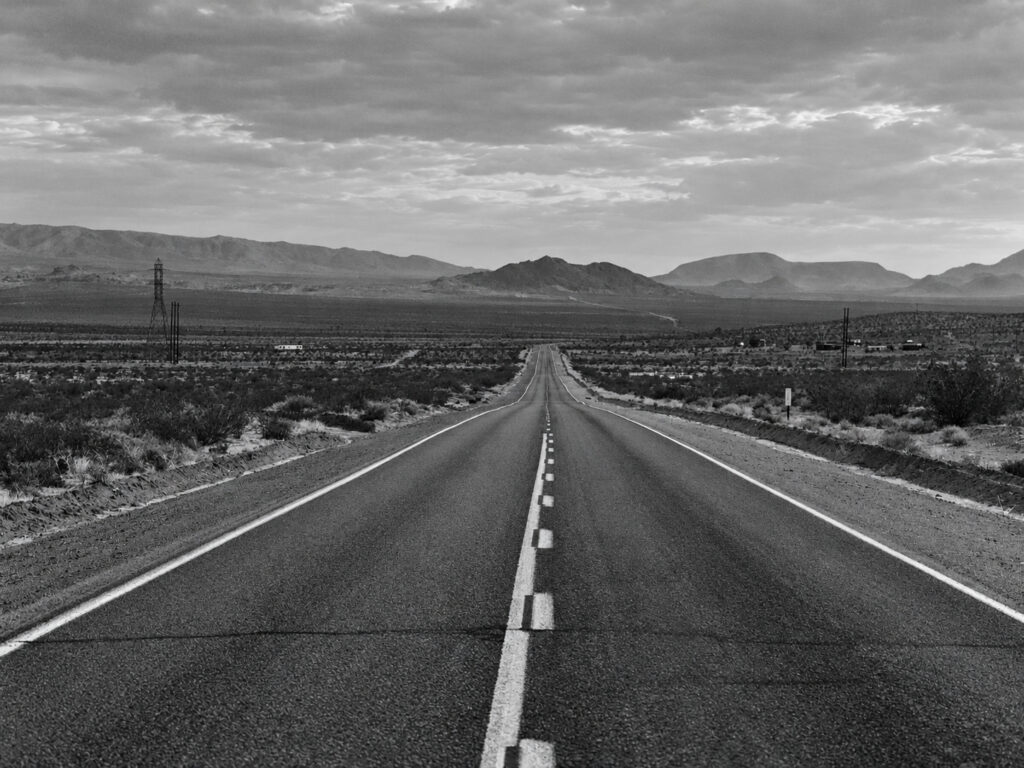
The highway running towards the mountains offers another example. It descends through dry country, following a line so straight that its construction appears almost improbable against the uneven ground. The road surface is dark, the markings clear, and the mountains rise in pale layers some distance ahead. There is little traffic to interrupt the view. It would be easy to regard the scene as an expression of freedom, with nothing visible to prevent movement towards the horizon. That interpretation belongs as much to the photographs and films we have seen as to the road itself. Someone has surveyed this route, laid the asphalt and maintained the markings. The apparent freedom depends on a substantial amount of work, most of which takes place outside the photograph.
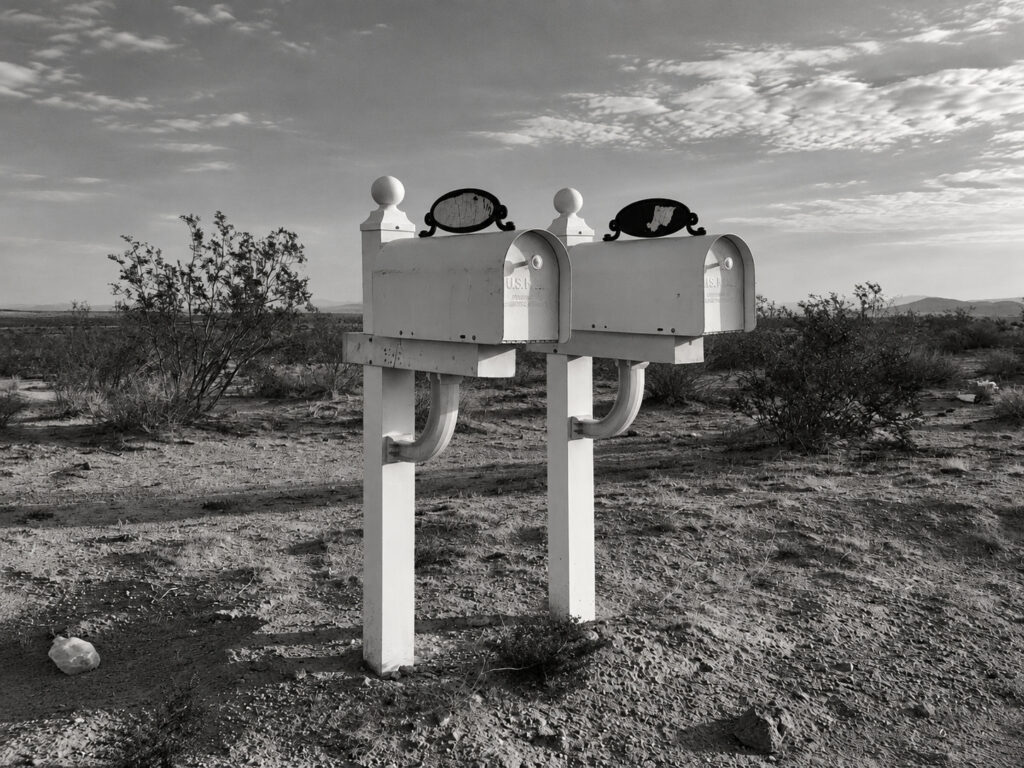
Not far from this familiar image of the open road are two white mailboxes. They stand together in an otherwise sparse landscape, their posts planted in rough ground. There is something slightly incongruous about them. A mailbox ordinarily belongs beside a house, a gate or a street where the arrangement of domestic life is readily understood. Here the houses are not apparent. Nevertheless, somebody presumably expects letters and parcels to arrive, and a postal worker has a route that includes these two small structures. They provide evidence of ordinary commitments in surroundings that, photographed differently, might appear uninhabited. I found myself wondering how far away the owners lived, and whether the arrangement seemed as unusual to them as it did to someone passing through.
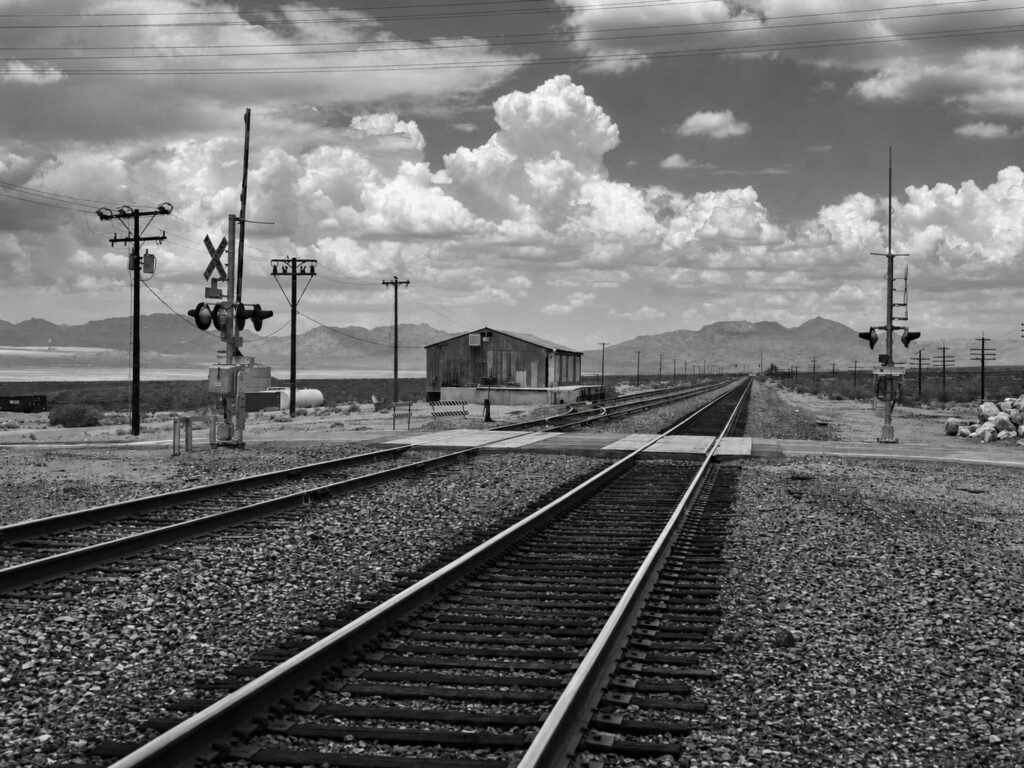
The railway crossing is another place where a great deal of organisation has been reduced to a few visible objects. Steel rails run across the road and continue towards a low building, with poles and crossing signals standing on either side. There is no train. Nothing appears to be happening, although the equipment is there precisely because something eventually will. A driver might spend only a few seconds crossing the tracks, unless the barriers were down. In a photograph, the place becomes something to examine at leisure. The rails, the lines of the road and the electrical equipment describe a system that extends well beyond the landscape. It seems remote, but it is connected to other places by the very infrastructure that makes the scene interesting.
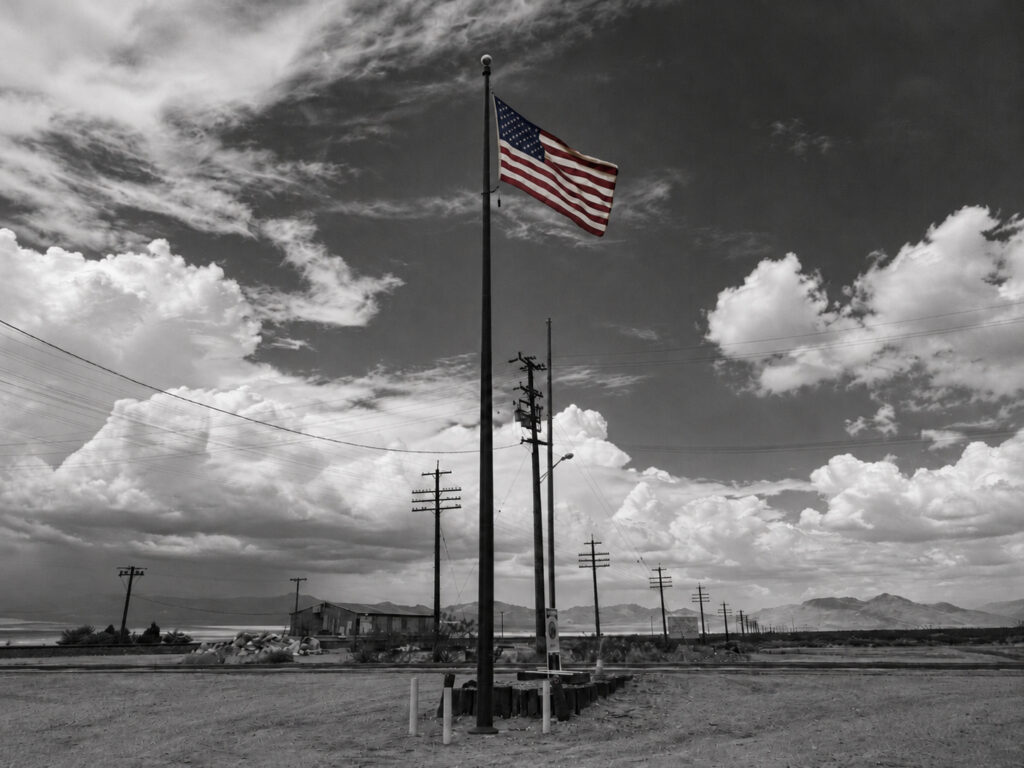
An American flag flies above another roadside setting. Against the large sky it is immediately recognisable, even before the surroundings have been considered. Flags make unusual photographic subjects because much of their meaning is supplied in advance. The viewer rarely has to ask what the object represents. But there is still the actual flag to consider: the fabric, the pole and the wind holding it away from the mast. Beneath it is an ordinary place, with buildings, utilities and a landscape subject to the weather. The symbol does not cease to be a symbol when photographed this way. It simply becomes possible to look at it as an object as well, one that somebody has put there and must occasionally maintain or replace.
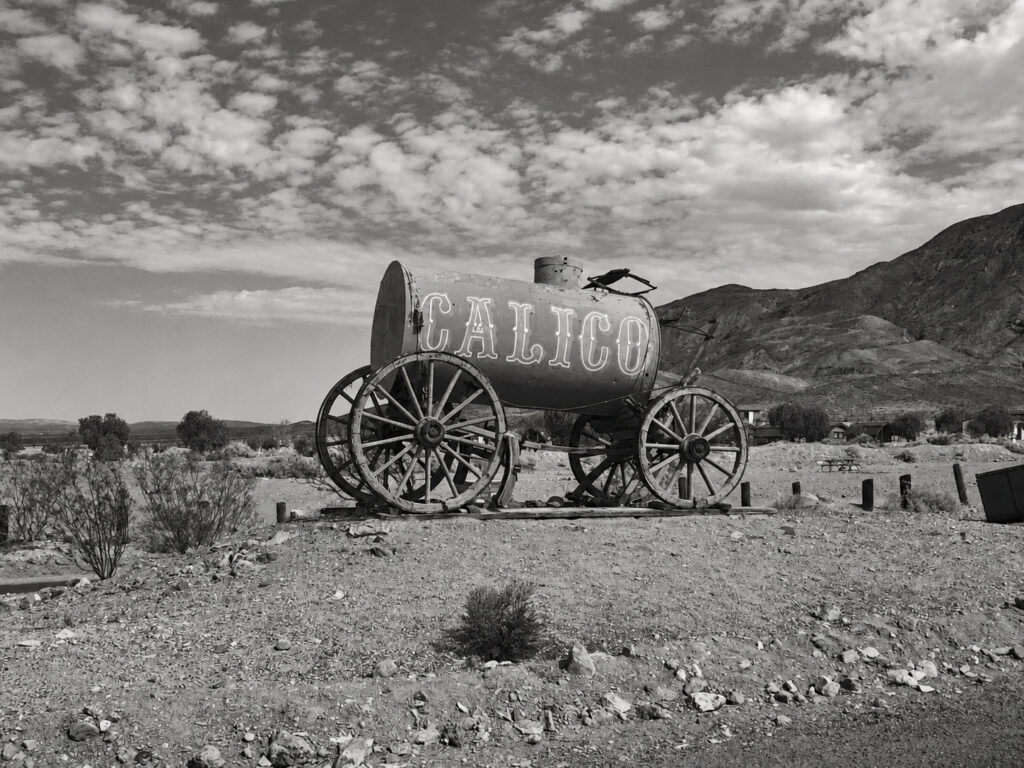
Calico presents a rather different problem. The former mining town in California has been preserved for visitors, and its appearance is part of the attraction. A wagon bearing the name CALICO stands against the bare hills, its large wheels and timber construction readily associated with the nineteenth-century West. The object belongs in the setting, although not in the uncomplicated way that a working wagon might once have done. It is there to help visitors understand, or perhaps imagine, a particular period. That distinction is worth considering because preservation always involves decisions. Something must be retained, repaired, reconstructed or removed. Even where the surviving material is genuine, the experience of seeing it has been arranged.
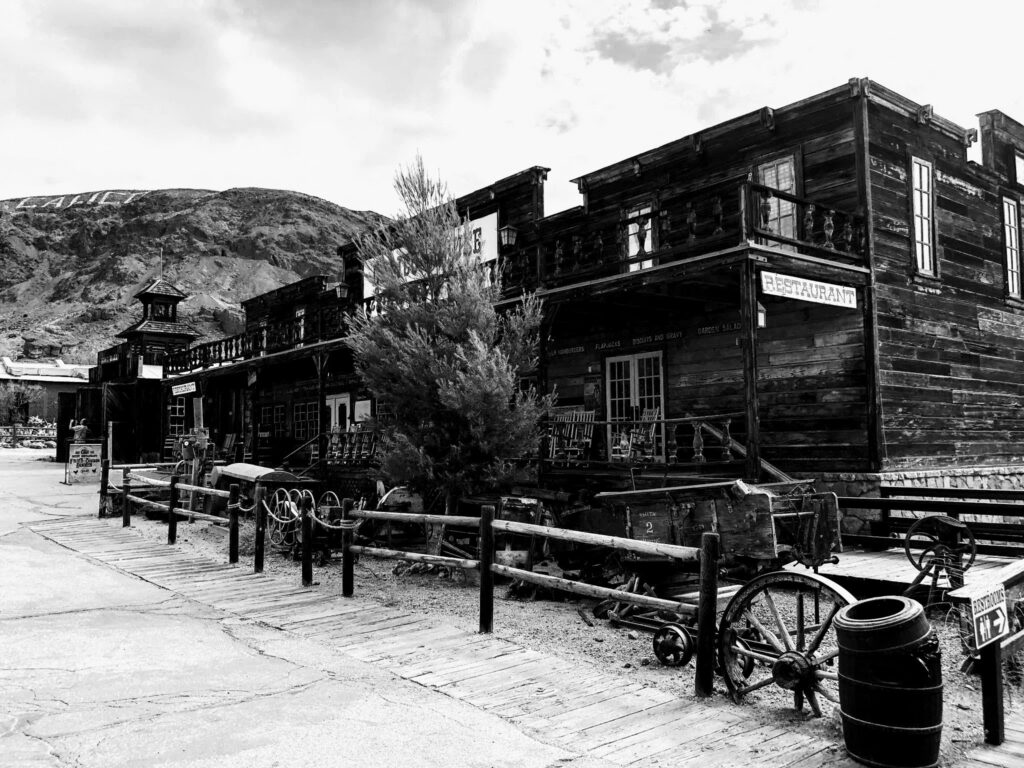
Further into Calico, the saloon and restaurant occupy a row of dark timber buildings beneath the bare hills. The wooden walkway, railings, old wheels and signs provide much of what visitors expect to find in a Western town. Photographed in black and white, the buildings can appear to belong to an earlier century, although this picture was made in 2018. That impression deserves some caution. The surviving and reconstructed structures serve a present-day attraction, with people maintaining them and visitors arriving to see them. I was interested in the difference between the age suggested by the scene and the ordinary arrangements keeping it in use.
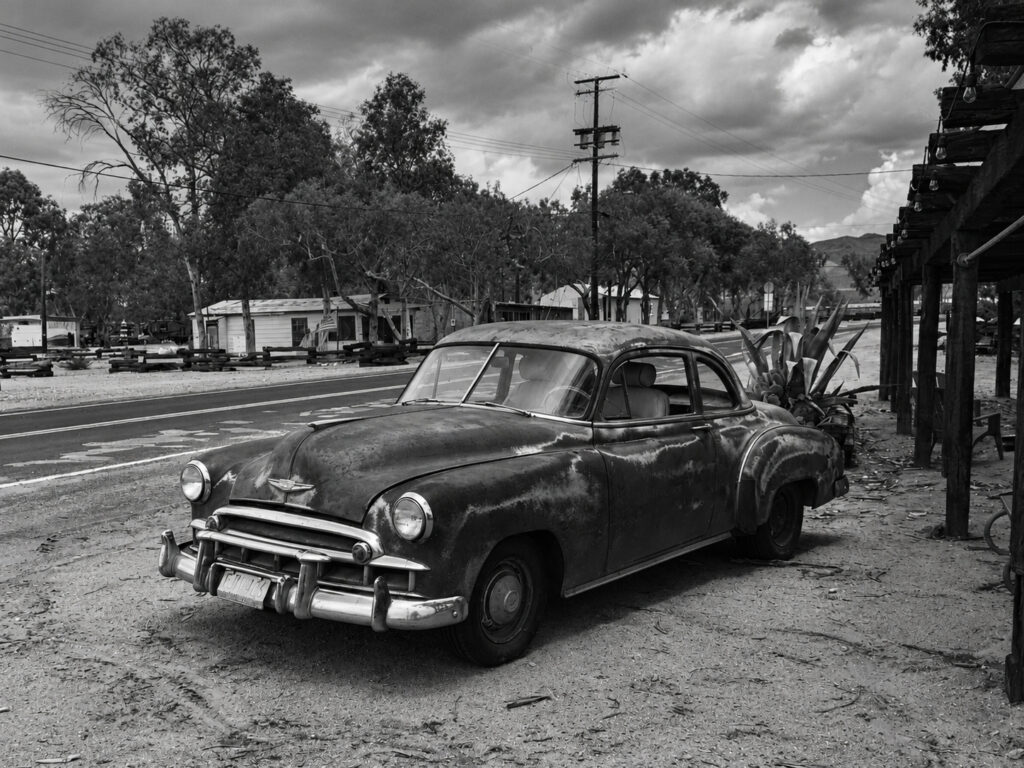
A weathered car parked beside the road seems less deliberately presented. Its paint has deteriorated and the bodywork shows its age, but its shape remains recognisable. It was made to travel, and now it stands still. There is no particular mystery in this. Cars wear out, become too expensive to repair or simply cease to be useful to their owners. Yet an old American automobile can carry an extraordinary amount of cultural baggage, especially when viewed from elsewhere in the world. Films have made certain body shapes and periods familiar, sometimes more familiar than the vehicles that actually occupied the roads at home. In this case, the damage and weathering were at least as interesting as the design. They suggested the ordinary history of an object that had continued existing long after its period of novelty had passed.
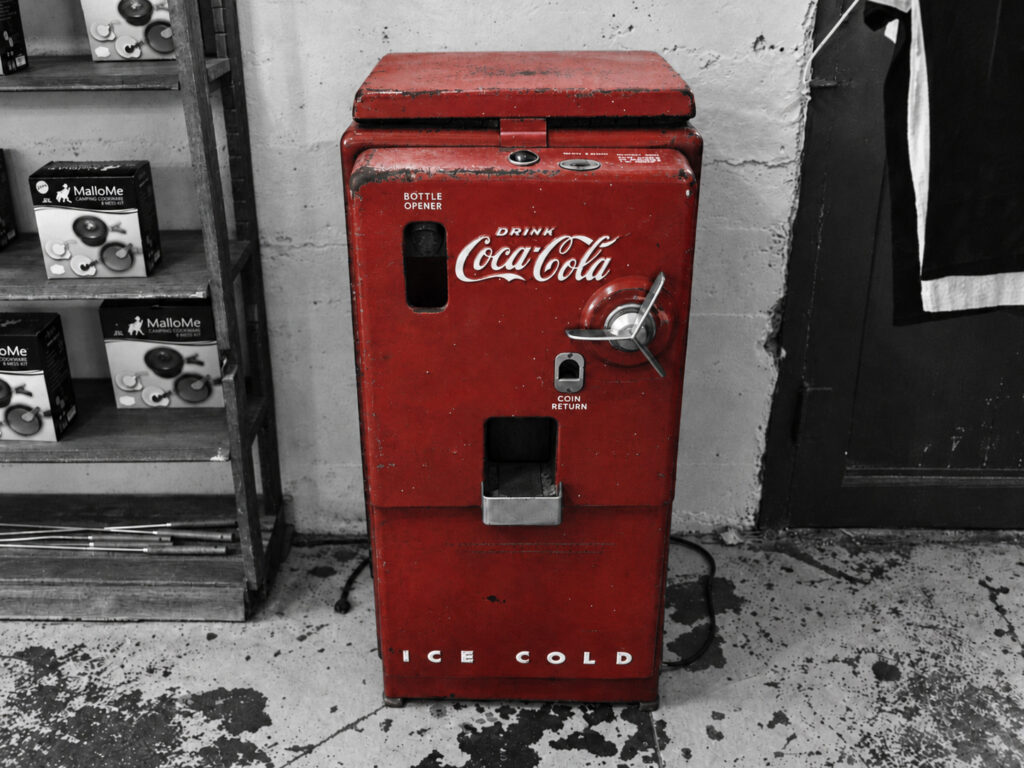
The red Coca-Cola cooler belongs to another part of that history. It is a practical commercial object, built to store and sell drinks, but its appearance has outlived the particular circumstances in which it was useful. The lettering and colour remain recognisable even where the equipment has aged. There is a distinction between the history of a product and the history of its advertising, though the two are often difficult to separate. Coca-Cola has been selling drinks for generations, and objects bearing its name have become collectible partly because the branding is so familiar. The cooler may once have been nothing more remarkable than a piece of equipment in a shop. Time has altered how people look at it, without necessarily altering what the object is.
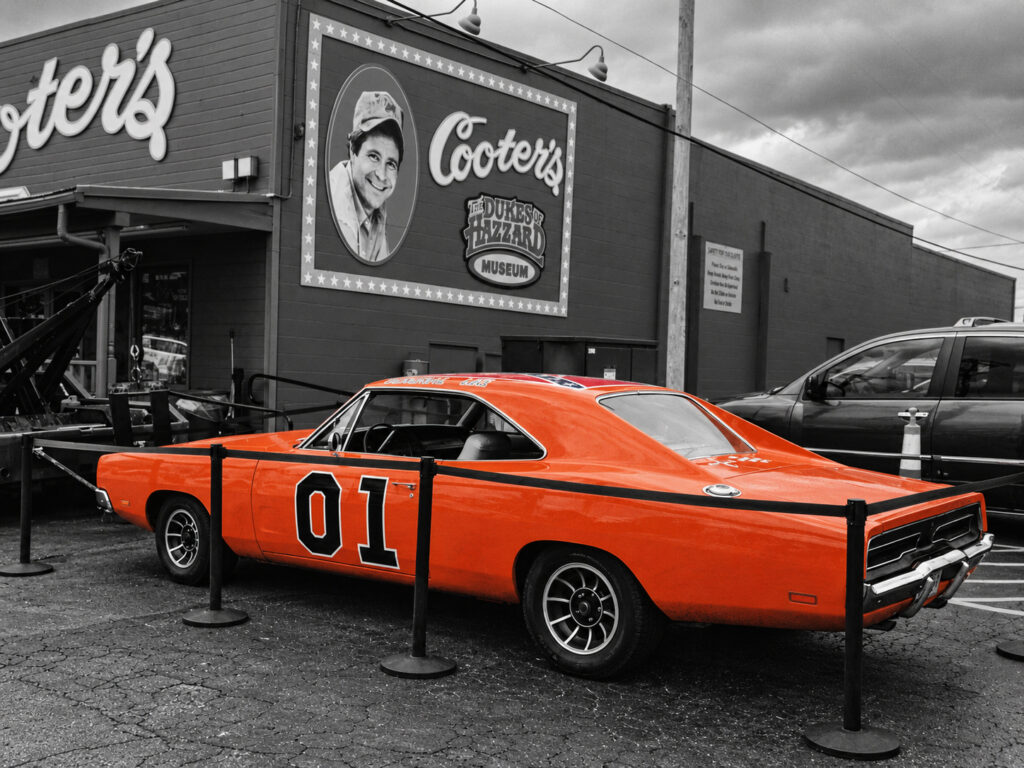
The orange car outside Cooter’s museum in Tennessee is more deliberately connected to popular culture. The number 01 is painted on its side, and the vehicle carries the styling of the General Lee from The Dukes of Hazzard. The television programme gave the car a second identity, one that has survived well beyond its original broadcasts. There are many cars of this general period, but comparatively few that can be recognised immediately by their colour and door markings. What interested me was the way the object existed in two places at once: physically outside a building, and imaginatively within a television series watched by people across several generations. The car is real enough, whatever its relationship to the original production vehicles. Its significance, however, depends heavily on something that happened elsewhere.
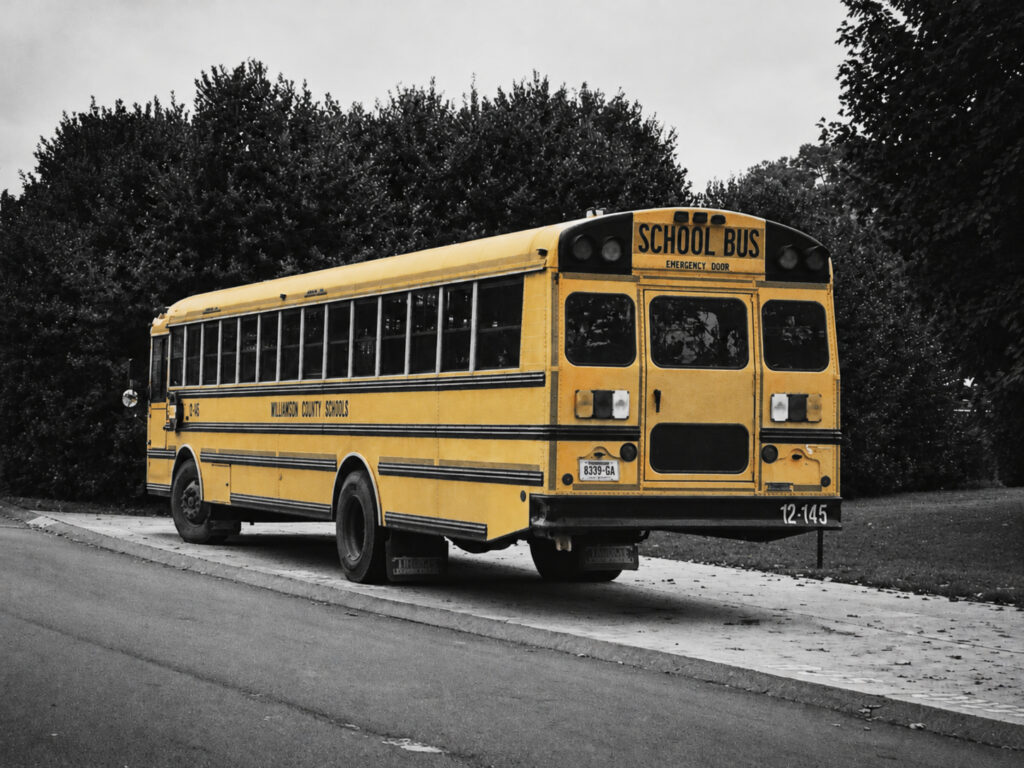
The yellow school bus is a more ordinary machine, although its appearance may be just as familiar to someone outside the United States. This one was parked beside the road, with its long row of windows, rear emergency door and black lettering clearly visible. It is an exceptionally practical design. Children need transporting, routes must be followed, and drivers require vehicles that can be identified quickly by other motorists. Much of the bus’s form follows from those requirements. Nevertheless, its bright yellow colour and distinctive proportions have made it a fixture in American films and television. I was looking at a piece of everyday equipment, but it was difficult to separate it entirely from years of fictional schooldays, departures and journeys. That says rather more about the reach of American popular culture than about the bus itself.
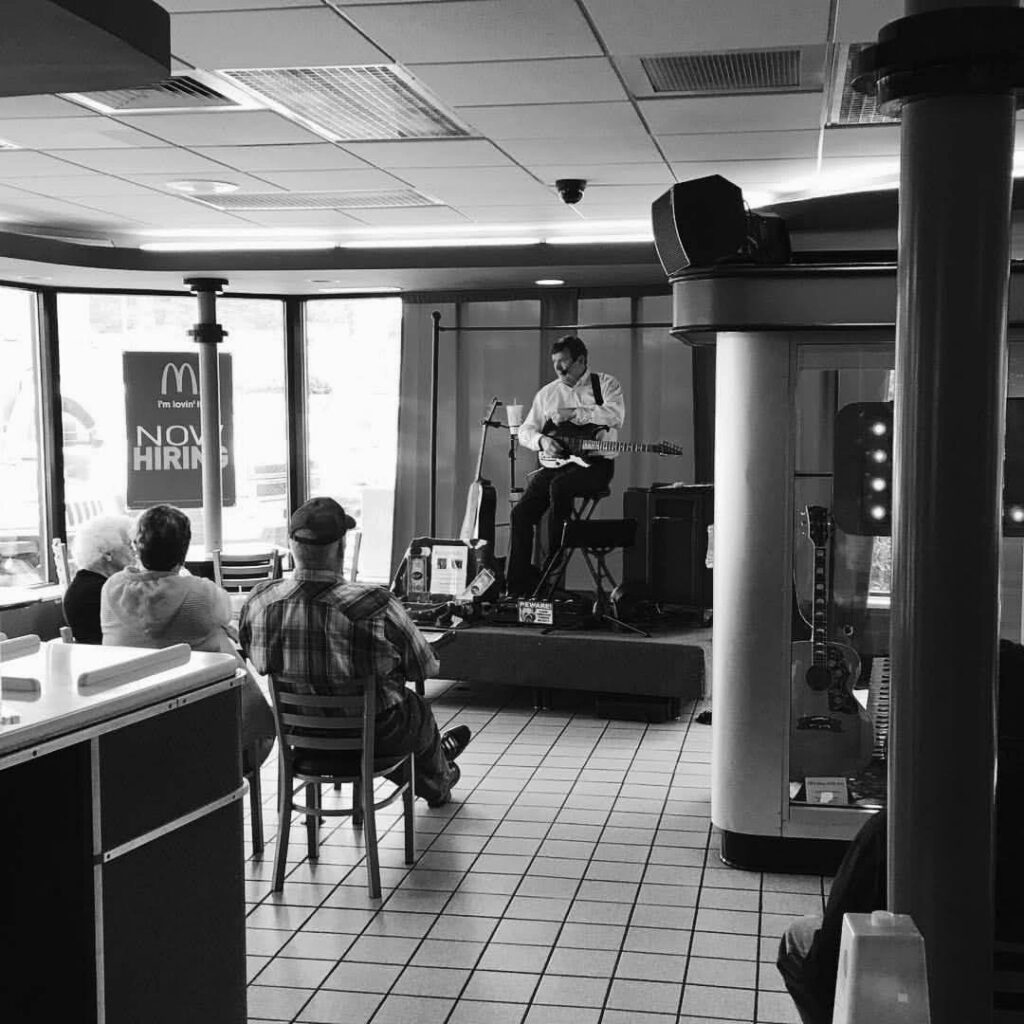
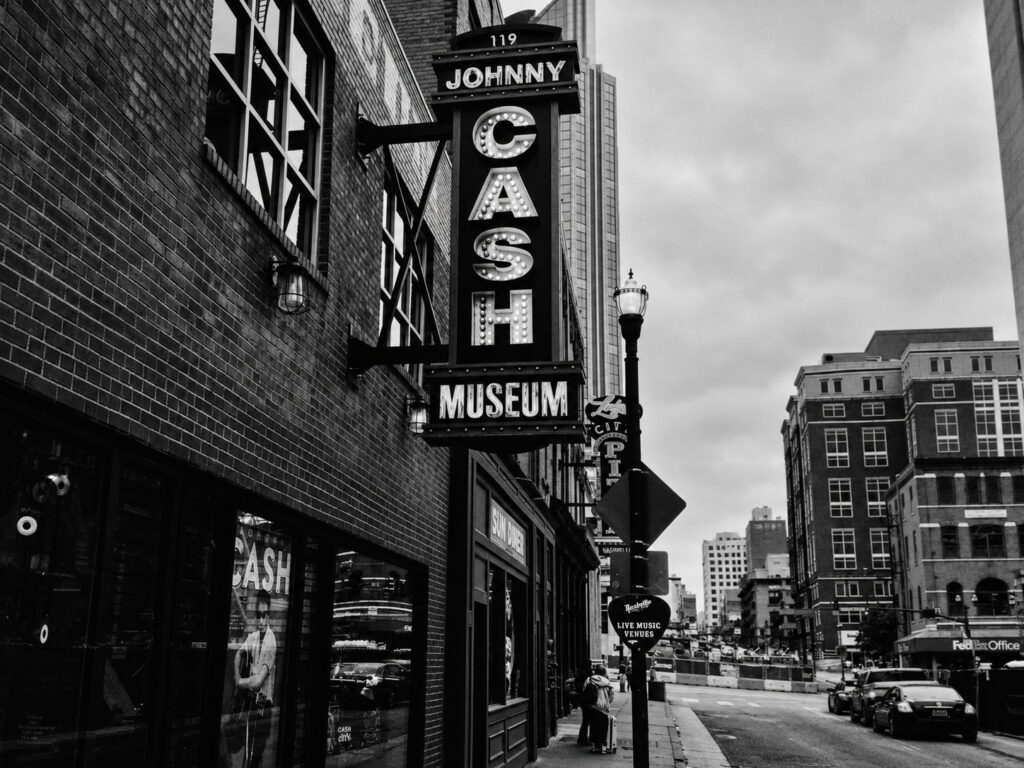
In Nashville, the sign for the Johnny Cash Museum stands out from the surrounding buildings. Its letters are arranged vertically, extending above the pavement and drawing the eye away from the street. The museum provides a physical location for the life and work of a musician whose recordings have travelled far beyond Tennessee. A name that exists for many people as a voice, a photograph or a record sleeve has acquired an address. Around the sign, the city continues in the usual fashion. Cars are parked, pedestrians use the pavement, and other businesses occupy nearby buildings. The museum is significant because of whom it commemorates, but it is also part of an ordinary urban street. It seems reasonable that both things should be true.
Las Vegas takes these relationships between recognition and reality further. At the New York-New York hotel, an arrangement of towers recreates the impression of another American city. The skyline is compressed, with buildings of different styles assembled into a composition intended to be recognised at once. A person need not have visited New York to understand the reference. Indeed, familiarity with the city’s representation in film and photography may be quite sufficient. The hotel is not trying to reproduce the experience of living or working in New York. It offers an immediately legible appearance, along with the accommodation and entertainment for which it was built. Photographed in black and white, the towers become a dense collection of windows, edges and decorative features. I found the construction interesting in its own right, quite apart from the city it was meant to suggest.
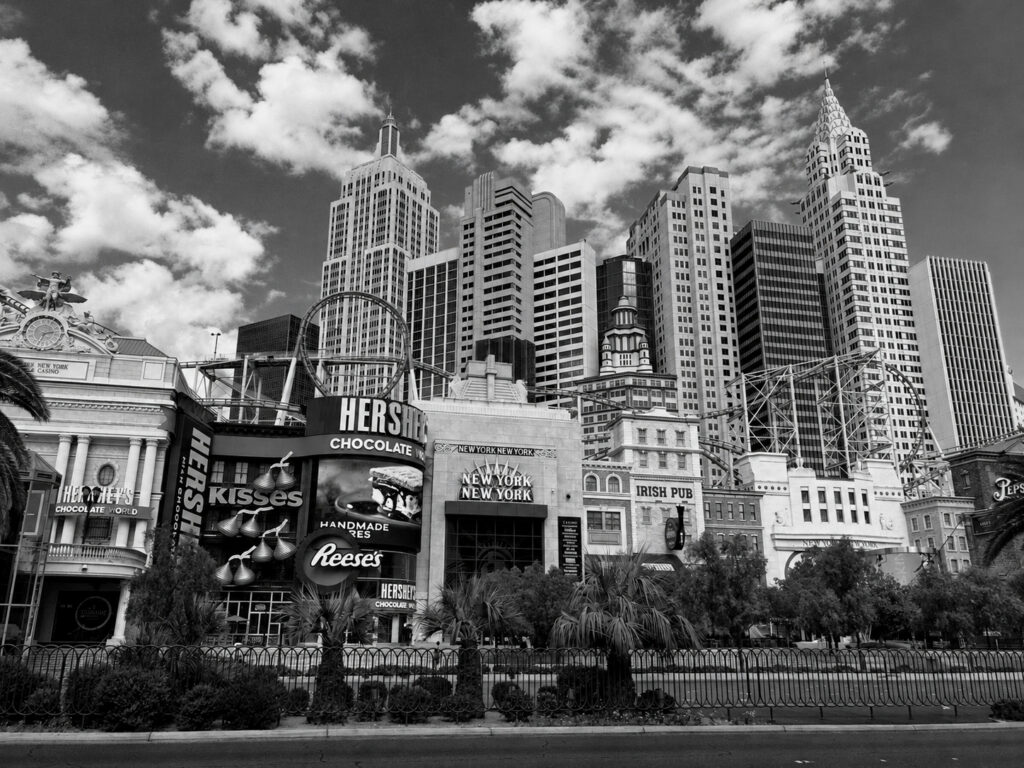
There is considerable engineering behind the illusion. The buildings have to function as hotels and commercial premises, whatever architectural references appear on their façades. Staff arrive for work, deliveries are made, equipment is repaired, and the familiar routines of a large business continue behind the spectacle. This practical side of Las Vegas can easily disappear from a photograph, particularly one composed to emphasise its more theatrical qualities. Yet the same could be said of almost any famous landscape. We rarely see the maintenance, administration or labour that allows a place to look the way it does.
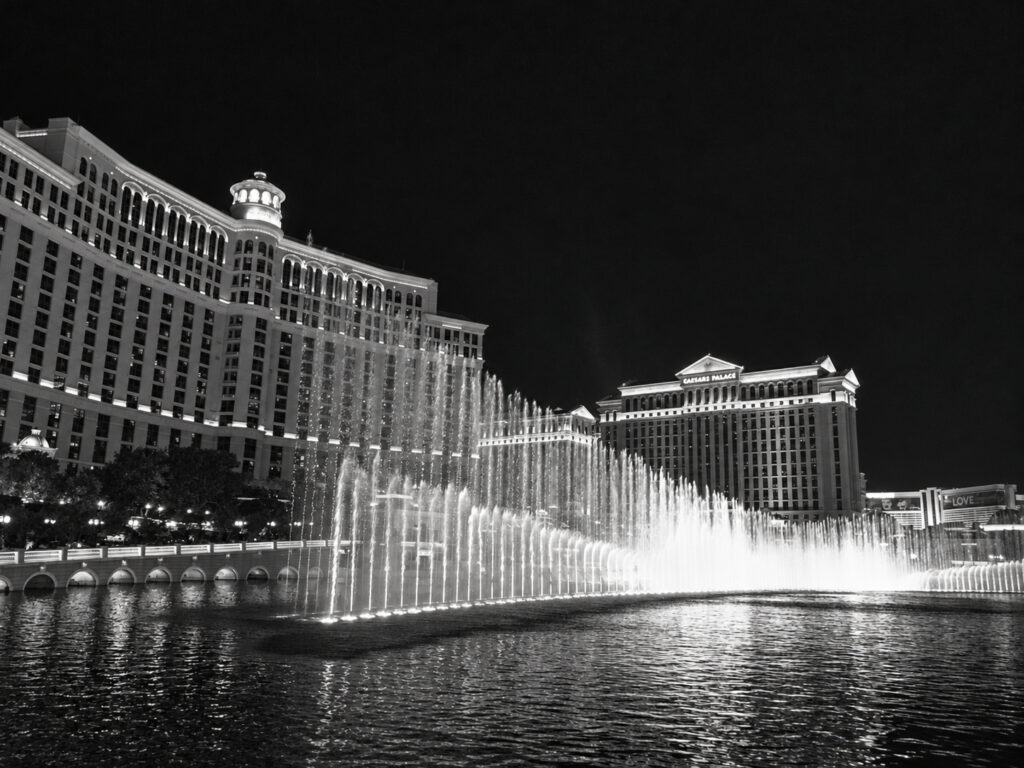
At the Bellagio, water rises in long illuminated columns against the hotel at night. The fountains are organised to perform for an audience, changing height and arrangement over a carefully controlled interval. Water is a particularly effective material for this purpose because it never holds its form. What appears in one instant has already changed in the next. A photograph can record only a small part of the performance, fixing a particular arrangement of jets and light that the spectators themselves would have seen for perhaps a fraction of a second. It is an impressive display, particularly in a desert city, though the practical questions surrounding so much moving water are difficult to ignore. The spectacle is temporary, but the machinery required to produce it is permanent and substantial.
Looking back through the photographs, I notice how often a familiar object became more interesting once its usual associations were set aside for a moment. The road sign was damaged paint on asphalt. The flag was cloth held in the wind. The school bus was a parked vehicle with a timetable and a purpose. Even the more theatrical subjects had ordinary physical requirements. That does not mean their wider meanings were somehow false. A preserved town can contain real history while presenting a selective version of it. A replica car can be an imitation and still be an object worth looking at. The distinction between authentic and manufactured becomes less useful when applied too confidently to things that people actually build, preserve and use.
Photography complicates this further because the camera makes selections of its own. It excludes as much as it records, and the resulting image may reinforce an existing impression even when the photographer had another reason for stopping. The empty street at Calico looks older without people and colour. The road towards the mountains appears almost limitless because its destination cannot be seen. The New York-New York skyline is more convincing when the surrounding city is left outside the frame. None of these decisions necessarily makes the photograph dishonest. They do, however, influence what a viewer is likely to understand from it, particularly when the subject is already familiar.
There is also the question of what recognition prevents us from noticing. Once an object has been identified, attention tends to move on. We know the bus, the flag, the brand or the car, and the mind supplies much of the remaining information. The photograph may then become confirmation of something already believed. Yet its smaller details can resist that process. The cracked road surface, the shadows beneath the mailboxes, the wear on the car and the ordinary buildings surrounding a famous name belong to the particular occasion on which the image was made. They are less easily absorbed into the ready-made story.
These photographs cannot describe the United States in any comprehensive way. They were made in particular places during particular journeys, and their selection reflects what caught my attention. Other routes and different interests would have produced another collection entirely. I do not think the images reveal some hidden, more authentic America beneath the familiar one. The signs, replicas, brands and preserved buildings are part of the country too. They have been made, maintained, used and sometimes deliberately arranged for people to look at.
What remains interesting is the space between arriving somewhere with an established picture in mind and finding the actual place in front of you. Sometimes the two correspond closely. At other times, an overlooked detail changes the experience completely. I cannot say that the camera resolves that difference. It may even contribute to it. But examining a familiar subject carefully, rather than accepting recognition as the end of the encounter, seems a reasonable place to begin.
About the photographer
Neil Wildin is an independent documentary photographer based in São Paulo. More of his work: wildin.com.br