
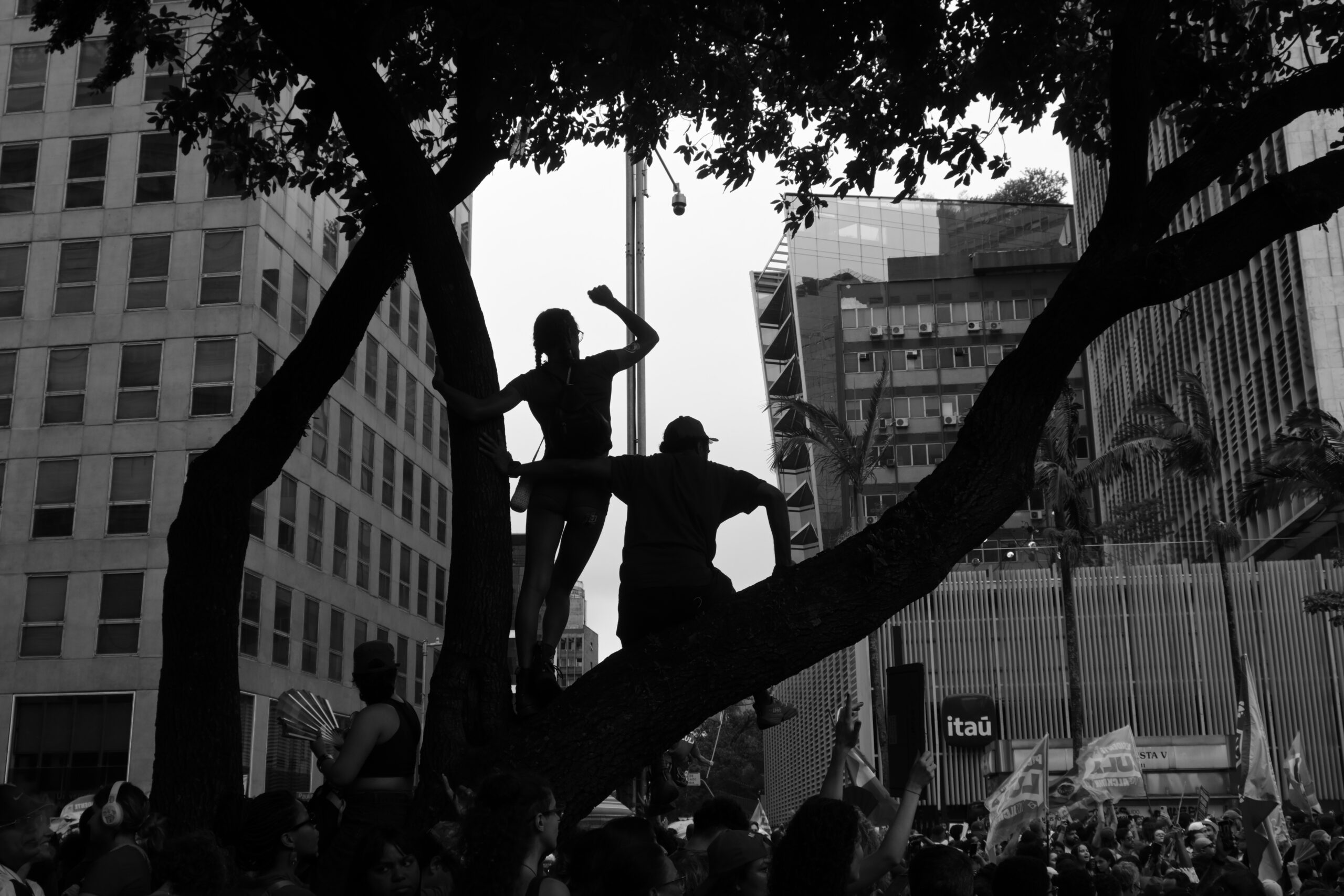
Cover: A Different Perspective. Avenida Paulista, São Paulo, Brazil · 11 October 2026. Photo: Neil Wildin.
What a Photograph Proves, and What Others Make It Mean
A critical essay on how documentary photographs change purpose across editorial contexts—and how responsibility follows each new use.
An essay by Neil Wildin
On 11 October 2026, I took my camera to Avenida Paulista in São Paulo. There was a political demonstration taking place, and I wanted to photograph it. The avenue offered plenty to work with: crowds, flags, people moving between buildings, and the occasional moment when an individual gesture stood out against everything happening around it.
I was interested in making photographs that worked visually, with the possibility of publishing them afterwards. I wasn’t there to argue for a political party or to discover what individual demonstrators believed. Those might have been legitimate reasons for attending, but they weren’t mine.
I made approximately a hundred photographs and eventually selected fourteen. Some were stronger compositions than others. A person’s position within the frame could make the difference, as could the direction of a flag, the relationship between figures, or the amount of space surrounding them. There were photographs that recorded the demonstration perfectly well but were less interesting to look at. Those didn’t make the selection.
This is an ordinary part of photographic work. You make more pictures than you need, examine them afterwards, and decide which are worth keeping. What I hadn’t considered particularly carefully was how differently the selected images might be understood once somebody else began making decisions about them.
Within days, photographs from the series had appeared in two publications.
Two publications, two purposes
Urban Frontier Insights published The Act of Looking as a photographic essay concerned with public space, observation and the position of the photographer within a gathering. The photographs formed part of a piece about looking at people who were themselves watching, recording or participating in an event.
Popular Mais used black-and-white photographs from the same series alongside an article about Brazil’s political future.
The difference caught my attention.
Both publications were using photographs made on the same afternoon. The people, buildings, flags and gestures hadn’t changed. Neither had my reasons for taking the pictures. But each publication had placed them within a different account of what was happening.
In one setting, a man raising his telephone became part of a discussion about photography and public witnessing. In another, images of the demonstration accompanied a political argument.
I was pleased to see the work published. That had been one of my objectives when I went to Avenida Paulista. There was no particular contradiction in being satisfied with both appearances, and I wasn’t offended that a political publication had used the photographs in a political context. A demonstration is a political event, whether or not the person photographing it has a political purpose.
Still, there was something about seeing the pictures in those two places that made me examine them again.
The publications had given the images different jobs to do.
I had chosen the pictures because of what I could see through the camera and what I thought they achieved as photographs. The editors had other considerations. They were addressing different readers, working within different editorial purposes, and deciding how the images would contribute to the material around them.
None of this necessarily made either publication misleading. It did, however, expose a weakness in any assumption that the meaning of a photograph is settled when the shutter is pressed.
What was actually there?
One of the photographs, Witness to the Crowd, shows a man holding his telephone above the gathering.
He is looking towards something beyond the immediate foreground, using his phone to make a record. I was looking at him through my camera. Whatever he photographed became part of his record, while his act of photographing became part of mine.
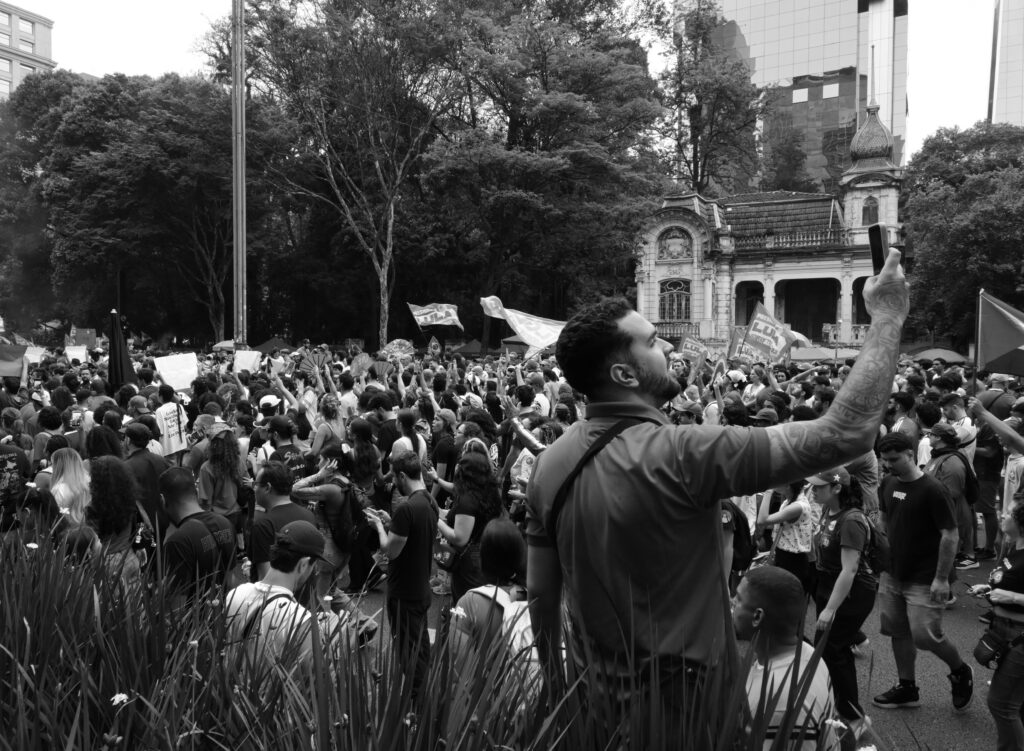
I don’t know what he intended to do with his picture.
He might have wanted a personal reminder of the afternoon. Perhaps he intended to share it with friends, post it online or demonstrate that he had attended. He might have been interested in the politics, the size of the crowd or simply what was happening around him.
All I can say from my photograph is that he was holding up his telephone and apparently recording the scene.
That is a rather limited piece of information, but it is a reliable one.
When the photograph was published, the situation changed for him as well as for me. He became visible to people who had never attended the demonstration, and his appearance was now surrounded by an editorial argument that he hadn’t chosen.
He almost certainly knew people might photograph him in a public gathering. That doesn’t mean he could have anticipated this particular publication or its eventual readership.
I hadn’t anticipated it either.
The photograph itself remained exactly as I had made it, yet the circumstances in which strangers encountered his image had changed. I began to wonder how much could reasonably be inferred about him from his presence in the picture.
The answer seemed to be rather less than a reader might assume.
Attending a political demonstration is evidence of attendance. It may suggest an interest in the subject being demonstrated about, but it doesn’t necessarily establish the person’s reasons for being there, the extent of their agreement, or their views on every issue associated with the gathering.
Those things might be discovered through conversation or other evidence. They cannot reliably be extracted from a photograph alone.
An authentic photograph can support an incorrect interpretation. There is no contradiction in that. The picture may show precisely what was in front of the lens while the explanation attached to it goes much further than the available evidence allows.
What the other photographs tell me
Looking through the series again, I began to notice differences between the ways people had entered the photographs.
In The Message, a demonstrator holds a handwritten political sign above the crowd. The purpose of the gesture appears reasonably clear. The person is making a message visible to others, and the photograph records that act of public expression.
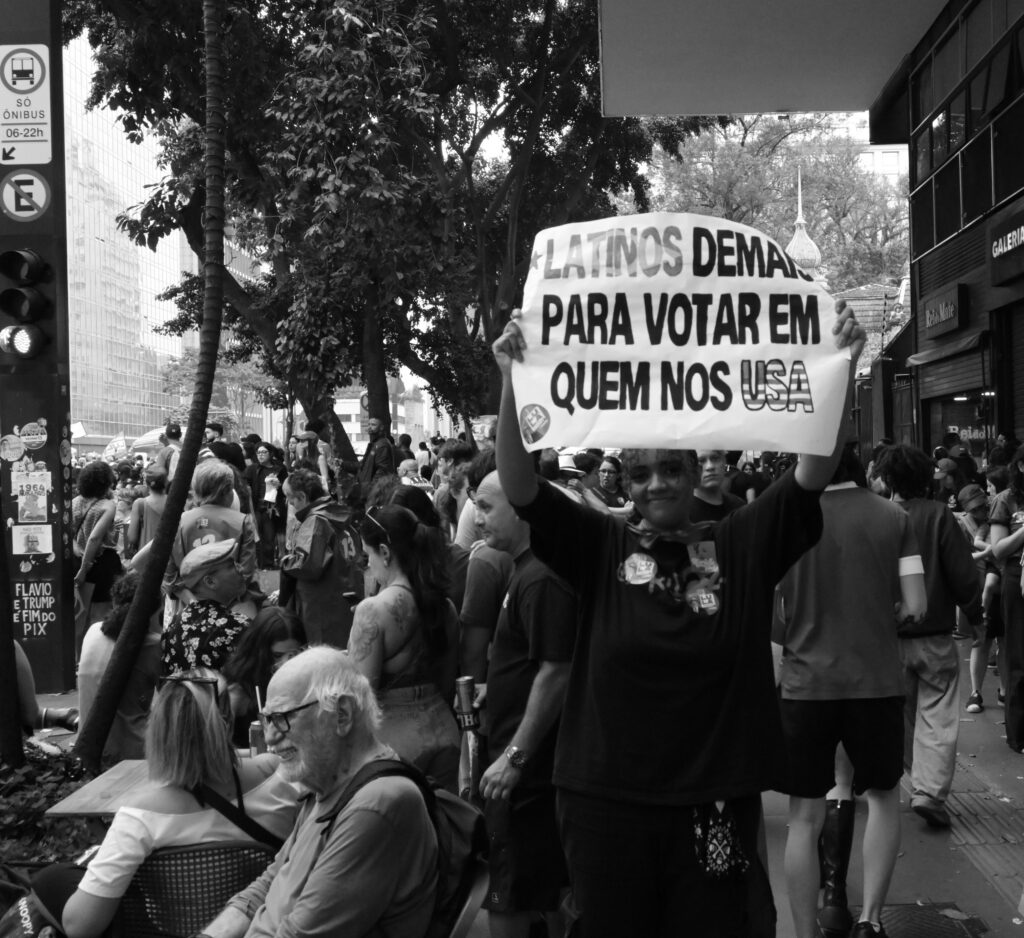
There is more evidence of deliberate communication here than in the photograph of the man holding his telephone.
Even so, the sign cannot tell me everything about the person displaying it. I can read the words and understand that they have been presented publicly. Whether those words express the person’s complete political position, a particular frustration, or a view held only in that moment is another question.
The difference matters. If someone deliberately makes a statement in public, a photographer has reasonable grounds for recording the statement as part of the event. It doesn’t follow that the photographer now knows the person’s entire political identity.
In Walking Together, attention shifts towards clothing, individual appearance and the movement of people along the avenue.
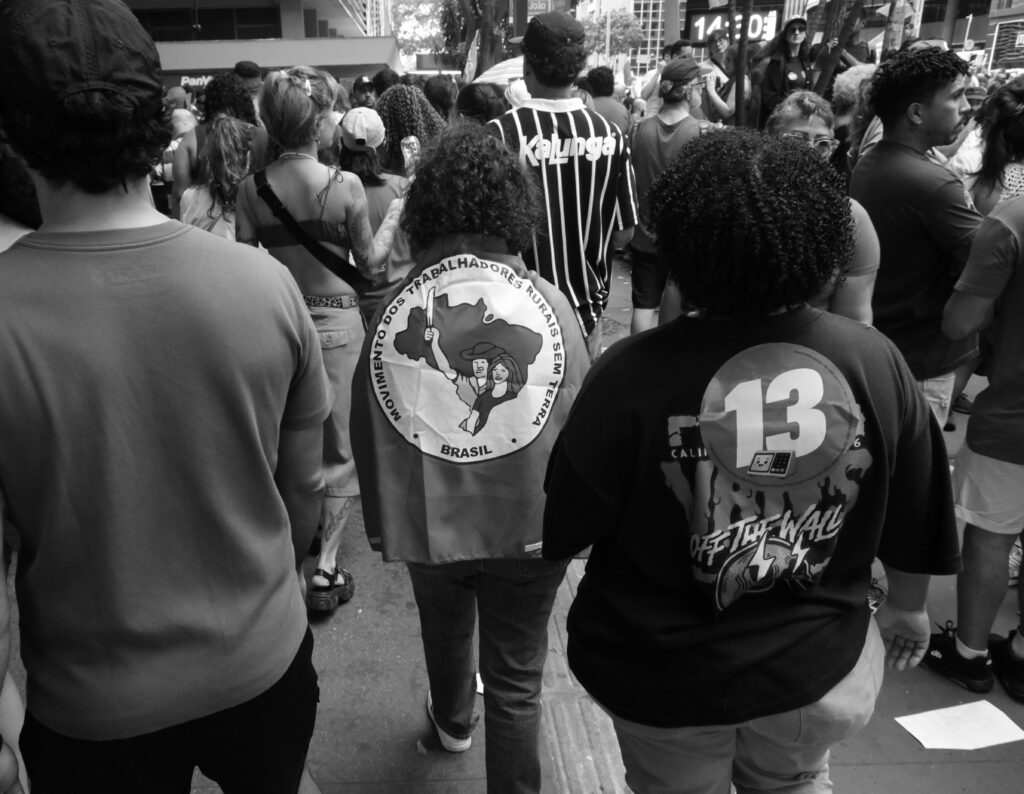
A phrase printed on a shirt may be immediately recognisable. So might a symbol, a badge or a particular colour. These details can be useful to a photographer because they distinguish one figure from another and create connections within the frame.
But recognition can be deceptive.
People wear things for all sorts of reasons. Clothing may express a deeply held conviction, a passing enthusiasm, a joke, a habit or something borrowed that morning. Sometimes the connection is obvious. Sometimes it isn’t.
The camera records the shirt, not the explanation.
Another photograph, A Different Perspective, shows people occupying the branches of a large tree above the demonstration.
It is an unusual arrangement, and that was what attracted me to it photographically. The branches offered a different set of lines and shapes from the street below. The people had found a position from which they could look out across the gathering, while I could photograph them against the structure of the tree.
Were they there to observe the demonstration, get a better view, escape the crowd or simply enjoy the unusual vantage point?
I don’t know.
The temptation is to give every visible action a meaning that fits the occasion. At a political demonstration, it becomes particularly easy to interpret all the people present through the politics of the event.
Yet the man with the telephone, the person displaying a sign and the people in the tree may have had quite different reasons for doing what they were doing. The photographs don’t remove those differences merely because they were taken on the same afternoon.
When visibility becomes exposure
There is a further difficulty when the person photographed is a child.
Imagine a young child holding a political flag at a demonstration. The child is plainly there, and the flag is plainly being held. A photograph can record both facts.
What it cannot establish is whether the child has independently understood and chosen the political position associated with the flag.
Perhaps the child is accompanying parents. Perhaps there has been a conversation about the gathering and the child understands something of its purpose. There may be other explanations as well.
A photograph cannot settle them.
Describing the visible action is one thing. Confidently attributing an adult political ideology to the child is something else.
I think this becomes particularly important when captions or accompanying articles add identifying details. A person may already be recognisable in a photograph, but attaching a full name, an address or other personal information can substantially increase the consequences of publication.
A photograph taken during an afternoon’s public activity can remain searchable for years. It may eventually be encountered by employers, acquaintances or people with entirely different interests from those of the original audience.
The person photographed might have no idea that the image has acquired this extended life.
Public visibility and unlimited personal exposure are not the same thing.
That doesn’t lead me to conclude that people should not be photographed at public events. Such photographs are an important part of the public record. But there is a difference between showing what happened and unnecessarily expanding the personal information attached to those who happened to be there.
Where that boundary should fall will depend on the circumstances. I don’t think there is a single rule that can resolve every case.
Who carries the responsibility?
The French-Israeli scholar Ariella Azoulay, in The Civil Contract of Photography, examines photography as a relationship extending beyond the person who operates the camera. The photographed person and the spectator are also involved in what she describes as a continuing photographic encounter.
I find that way of thinking useful because it prevents the photograph from being treated simply as an object belonging to its maker.
The people in my pictures did not cease to matter when I walked away from Avenida Paulista. Nor did the relationship between the photograph and its viewers end when the images were first published.
But the two publications made me consider another aspect of that relationship.
If responsibility continues after a photograph is made, who is responsible for what happens to it?
I can account for my own decisions. I chose where to stand, when to press the shutter, what to include within the frame and which photographs to select afterwards. I also had a part in deciding how the original work would be presented.
An editor makes another set of decisions.
The editor may choose which picture accompanies an article, how prominently it appears, what the headline says, and whether a caption identifies somebody or makes a claim about what the image represents.
Those decisions can materially affect how the photograph is understood.
A reader then encounters the combination and forms an opinion, sometimes carefully and sometimes with very little consideration.
These activities are connected, but I don’t think it is reasonable to treat them as a single act for which one person has unlimited responsibility.
If a publication places my photograph beside a political argument, that doesn’t automatically make the argument mine. The editor has selected the context and is responsible for the claims made within it.
Equally, I cannot assume that handing over an image ends my involvement entirely.
I remain responsible for the manner in which I made it, for what I say about it, and for risks I could reasonably have anticipated. There may also be circumstances in which a subsequent use gives me reason to act, even if I wasn’t responsible for the original editorial decision.
Suppose one of my photographs appeared beside a claim that was demonstrably false.
If I became aware of the problem, I would contact the editor and explain my concern. That would not make me the author of the false claim. It would mean I had discovered something relevant to the use of my work and had some opportunity to respond.
What happens next would depend on the facts, the seriousness of the error and whether the publication was willing to correct it.
There is an important difference between having caused a problem and having some responsibility to respond once you know about it.
The distinction is not always comfortable, but I think it is necessary.
A photograph changes hands
Photographs have always moved beyond the circumstances in which they were made.
They appear in newspapers, books, exhibitions, private collections and, increasingly, in digital settings where they can be copied or redistributed with very little difficulty.
An image may have one meaning within a photographic essay and another when placed beside a headline. A later publication might use it to illustrate something that occurred years after it was taken. Someone else may find it through a search engine without ever seeing the original work.
Each new setting introduces possibilities the photographer may not have anticipated.
It would be unrealistic to expect the person who made the picture to control every interpretation. I don’t think that would be desirable either. Photographs often become interesting precisely because people notice things their makers did not.
But interpretation and factual assertion are different activities.
A reader is entitled to think that the man holding his telephone represents something about contemporary political participation. That is an interpretation worth considering.
A publication claiming to know his personal beliefs from the photograph alone would be making a different kind of statement. It would need evidence.
Likewise, a photograph of a demonstration may legitimately accompany a political article. That doesn’t establish the political position of the photographer, or the precise beliefs of every person visible in the crowd.
The photograph supplies some information. The context supplies more. The difficulty arises when the added information is presented as though it had been established by the picture itself.
This is where I think responsibility begins to shift.
A photographer must be prepared to account for decisions made during the creation and original presentation of an image. A publisher must account for the further claims and exposure introduced through publication. If the image is used again, the circumstances of that new use need to be considered in their own right.
The responsibilities will not always be equal.
Much depends on who knew what, who had control over the decision, what consequences could reasonably have been anticipated, and whether somebody had the practical ability to respond once a problem became apparent.
A photograph might remain unchanged through all of these stages. The reasons for using it, and the demands placed upon it, may be quite different.
Looking again
When I first examined the photographs from Avenida Paulista, I was looking for the strongest images.
I considered composition, gesture, expression, the surrounding architecture and whether the frame contained enough information to hold a viewer’s attention. I discarded pictures that were repetitive or failed to work as I had intended.
That process still seems reasonable to me.
What has changed is the amount of attention I now give to what happens afterwards.
I don’t regret making the photographs, and I don’t believe Popular Mais did anything inherently wrong by publishing them alongside political commentary. The article had its own purpose, just as my photographs had theirs.
But the experience made me more aware of the distance between producing an image and seeing it used.
The man with the telephone remains in the frame. So do the demonstrator holding a sign and the people sitting in the tree. The photographs still show what I photographed that afternoon.
They have also been seen by people I will never meet, in circumstances I cannot fully reconstruct, and alongside words I did not necessarily write.
That isn’t an exceptional failure of photography. It is part of what publication does.
Once an image enters circulation, other people begin making decisions about it. Some may approach it carefully, while others may use it with less regard for the circumstances in which it was made. The photographer can sometimes intervene, but often has little knowledge of where the image has gone.
I am not convinced that responsibility can be assigned once, at the moment of exposure, and remain permanently settled.
There must be some account of the decisions made afterwards, particularly when a new use changes what readers are being encouraged to believe about the people photographed.
A photograph can be accurate without supporting every conclusion drawn from it. Someone can be visible without having made all aspects of their life available for public examination. And a publisher can make legitimate editorial decisions without those decisions becoming the personal views of the photographer.
These distinctions may appear straightforward when written down. In practice, they depend on individual circumstances, incomplete knowledge and judgements that sometimes have to be made without knowing every consequence.
I went to Avenida Paulista to make photographs. I came away with fourteen pictures I thought were worth publishing.
It was only after they appeared in print and online that I began asking quite different questions about them.
I suspect those questions will become more complicated as photographs move further from the people and events they originally recorded. The camera can establish that something was there. What happens when somebody decides what that evidence means is another matter.
About the photographer
Neil Wildin is an independent documentary photographer based in São Paulo. More of his work: wildin.com.br
Write for UFI
Have a story about cities? We publish articles and photo essays from researchers, practitioners and photographers.
Pitch us at contact@urbanfrontierinsights.com