
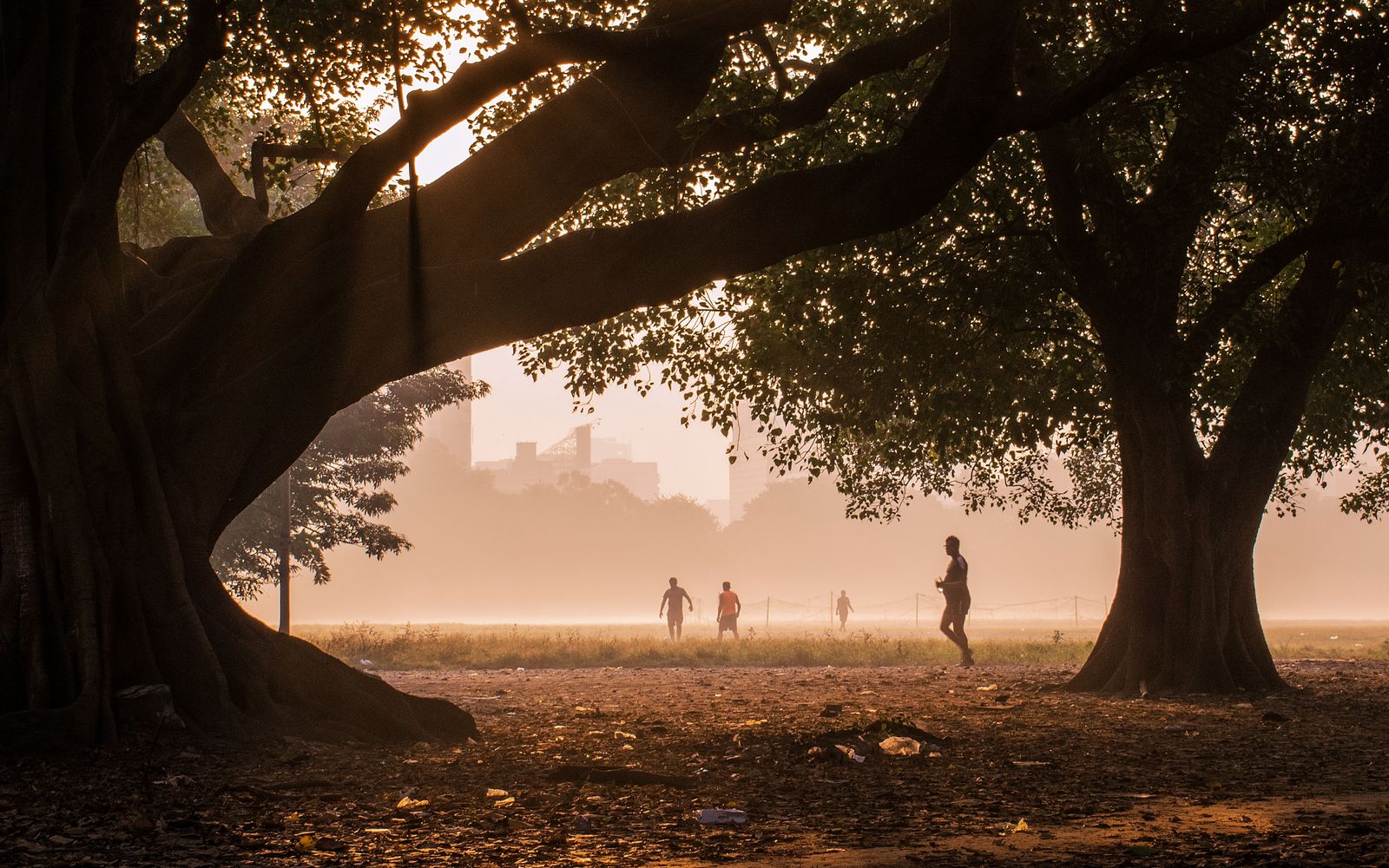
Step out of your front door and look around. How many trees can you see? Is there a patch of green, or a row of neem and gulmohar, within a minute’s walk? A new study from Sweden suggests the answer may matter for your brain decades from now. Researchers led by Stockholm University followed 2,993 people aged 60 and over for 16 years and found that those with more vegetation within 100 metres of home had about a 20 per cent lower risk of developing dementia [1, 2]. In our recent article on sleep as an urban health indicator, we argued that cities shape health through the everyday conditions of the places where people live. Green space may be the clearest example, with evidence spanning the whole life course.
The hundred metres that matter
The study, published this month in Alzheimer’s & Dementia, drew on SNAC-K, a population-based study of older adults in Stockholm. Each year, the team used satellite imagery and GIS to measure vegetation within 100, 250 and 500 metres of every participant’s home; 477 participants developed dementia during follow-up. The link was strongest within 100 metres, weaker further away and more pronounced among women, and it held after accounting for age, education, socioeconomic circumstances, lifestyle, air pollution, traffic noise and proximity to water [1, 2].
The lead author, psychologist Cecilia Stenfors, notes that her group’s wider research has also linked residential greenspace with better sleep, better mental health, higher life satisfaction and lower use of antidepressants [2]. The pathways probably run through rest, mood, movement and social contact together.
Some caution is due. This is an observational study from a single city, and it shows association, not cause. A 2022 dose–response meta-analysis of 12 studies found no overall association between greenness and dementia when the greenest and least green groups were compared, though it found hints of lower risk at intermediate levels and flagged exposure misclassification as a problem [3]. A systematic review of 25 studies across the lifespan called the evidence on green space and cognition “inconsistent but suggestive” of benefit [4]. Stockholm’s annually updated measure of greenery at the doorstep is a step towards firmer answers.
Growing brains in greener places
If green space helps protect the ageing brain, it may also help build the young one. In Barcelona, Payam Dadvand and colleagues followed 2,593 children aged 7 to 10 across 36 primary schools for a year. Children whose schools had more greenery showed greater gains in working memory and a larger fall in inattentiveness. Traffic-related air pollution accounted for 20–65% of the association, suggesting that greenery helps partly by buffering street pollution [5]. A brain-imaging study of 253 schoolchildren from the same project linked greater lifelong residential greenspace with larger grey matter volume in parts of the prefrontal cortex, some of which overlapped with regions associated with better working memory and attention [6].
The effects may last. A Danish study of nearly a million people tracked the greenness around each child’s home from birth to age 10. Those who grew up with the least green space had up to 55% higher risk of developing a psychiatric disorder later in life, independent of socioeconomic factors and family psychiatric history, and the link was strongest in the most urbanised areas [7]. The World Health Organization’s 2016 European evidence review had already noted beneficial effects of green space on children’s mental health and cognitive development [8]. For Indian cities, this should reshape how we site schools and playgrounds.
Stress, rumination and the restored mind
Why would trees matter to neurons? Stephen Kaplan’s attention restoration theory argued that natural settings help people recover from the fatigue of prolonged, focused mental effort, the kind demanded by traffic, screens and deadlines [9]. A decade earlier, Roger Ulrich had found that among 23 matched pairs of surgical patients, those whose windows looked out on trees left hospital sooner (7.96 versus 8.70 days on average) and needed fewer strong painkillers than those whose windows faced a wall [10].
Neuroscience is now catching up. In an experiment near Stanford University, city dwellers who took a 90-minute walk through grassland reported less rumination, the repetitive negative thinking linked to depression, and showed reduced activity in the subgenual prefrontal cortex; those who walked beside a busy road showed neither change [11]. In Berlin, among 341 adults aged 61 to 82, those living close to forest were more likely to have a physiologically healthy amygdala, a region central to processing stress, though the data cannot rule out healthier people choosing such homes [12]. Such studies form the core of neuro-urbanism and support frameworks that map urban environment indicators onto mental well-being [13].
The Indian picture: unequal green
Most of this evidence comes from Europe and North America, and Indian cities differ in climate and density. But the planning problem is familiar. In Bengaluru, the Garden City, a geospatial study of 198 wards found 19 with no park at all and 36 with only one. Between 25% and 29% of wards lacked a neighbourhood or community park within 400–800 metres, with gaps concentrated on the child-rich periphery, in eastern wards with a high Scheduled Caste population and in low-income areas [14]. A survey of the city’s street trees recorded about 104 trees per kilometre on wide roads but only 52 on narrow ones, even though street trees are often the most accessible green space for low- and middle-income residents [15].
The 100-metre finding makes such gaps sharper. A large park several kilometres away does little for an older woman who rarely leaves her lane. Our own research has examined perceived urban environments and mental well-being in Delhi [16], and the perceived quality of, and access to, urban green spaces in relation to loneliness in India [17], a theme also explored in our piece on urban design as a remedy for loneliness. What counts is green that is close, usable and cared for, not hectares on a master plan.
National programmes are adding green, with mixed results. The Nagar Van Yojana, launched by the Union environment ministry in 2020 and financed through the National CAMPA Fund, supports new urban forests. Down To Earth’s visits to 14 sites in Uttar Pradesh, Madhya Pradesh and Rajasthan, reported this month, found that state maintenance funds often arrive late from the second year, leaving caretakers unpaid and fences and toilets in disrepair [18]. As we argued in why India’s urban forests are dying, planting is the easy part; keeping green alive is where cities fall short.
What Indian cities can do
The Stockholm researchers recommend protecting existing vegetation and creating accessible green spaces for people with different needs and abilities [2]. A useful benchmark is urban forester Cecil Konijnendijk’s 3–30–300 rule: at least three well-established trees in view from every home, school and workplace; no less than 30% tree canopy in every neighbourhood; and no more than 300 metres to the nearest public green space [19]. For Indian cities, six priorities follow.
1. Green within a short walk of every home. Master plans and development control regulations should set proximity standards, such as public green space within 300 metres of every residence, and audit them ward by ward, starting with wards that have none [14, 19]. Pocket parks, sacred groves and lake edges all count.
2. Trees on every street, not just the wide ones. Narrow residential lanes need tree pits, shaded footpaths and room for canopy, and road-widening projects should count the cost of losing mature trees [15].
3. Green schools and green routes to school. Trees in playgrounds, planted buffers against traffic and greened boundary walls should become part of school infrastructure standards [5, 6].
4. Design for older adults at the doorstep. Shaded seating, level paths, lighting and toilets make nearby green usable for older residents, especially women [1]. Our article on urban environments and healthy ageing sets out further principles.
5. Protect and maintain urban forests. Nagar Vans need guaranteed multi-year maintenance budgets tied to inspections, with joint management by forest departments and urban local bodies after the first few years [18]. Protect existing groves before planting new ones.
6. Measure green alongside mental health. Track green space access, street tree cover and views of green from homes, schools and hospitals ward by ward, alongside indicators of sleep, stress and mental well-being [10, 13].
Brain health as a planning outcome
Indian planners have long justified parks in terms of recreation, beauty and, more recently, climate resilience. The evidence reviewed here adds another reason: green space near home appears to support the brain at every stage of life. The science is still maturing, and much of it comes from cities far from ours, but its direction is consistent enough to act on. A tree on a narrow lane costs little compared with the burden of dementia, depression and lost learning. A city that plans for brain health will be greener where people actually live.
References
1. Stenfors, C. U. D., Wu, J., Grande, G., Pyko, A., Löhmus, M., Pershagen, G., & Rizzuto, D. (2026). Precision residential greenspace, urban environmental exposures, and incident dementia among older adults in Sweden: A 16-year cohort study. Alzheimer’s & Dementia, 22(10), e71835. https://doi.org/10.1002/alz.71835
2. Stockholm University, Department of Psychology. (2026, October 20). Greenspace in the immediate surrounding of the home linked to lower dementia risk [Press release]. https://www.su.se/english/divisions/department-of-psychology/news/articles/2026-10-20-greenspace-in-the-immediate-surrounding-of-the-home-linked-to-lower-dementia-risk
3. Zagnoli, F., Filippini, T., Jimenez, M. P., Wise, L. A., Hatch, E. E., & Vinceti, M. (2022). Is greenness associated with dementia? A systematic review and dose–response meta-analysis. Current Environmental Health Reports, 9(4), 574–590. https://doi.org/10.1007/s40572-022-00365-5
4. Ricciardi, E., Spano, G., Lopez, A., Tinella, L., Clemente, C., Elia, G., Dadvand, P., Sanesi, G., Bosco, A., & Caffò, A. O. (2022). Long-term exposure to greenspace and cognitive function during the lifespan: A systematic review. International Journal of Environmental Research and Public Health, 19(18), 11700. https://doi.org/10.3390/ijerph191811700
5. Dadvand, P., Nieuwenhuijsen, M. J., Esnaola, M., Forns, J., Basagaña, X., Alvarez-Pedrerol, M., Rivas, I., López-Vicente, M., De Castro Pascual, M., Su, J., Jerrett, M., Querol, X., & Sunyer, J. (2015). Green spaces and cognitive development in primary schoolchildren. Proceedings of the National Academy of Sciences, 112(26), 7937–7942. https://doi.org/10.1073/pnas.1503402112
6. Dadvand, P., Pujol, J., Macià, D., Martínez-Vilavella, G., Blanco-Hinojo, L., Mortamais, M., Alvarez-Pedrerol, M., Fenoll, R., Esnaola, M., Dalmau-Bueno, A., López-Vicente, M., Basagaña, X., Jerrett, M., Nieuwenhuijsen, M. J., & Sunyer, J. (2018). The association between lifelong greenspace exposure and 3-dimensional brain magnetic resonance imaging in Barcelona schoolchildren. Environmental Health Perspectives, 126(2), 027012. https://doi.org/10.1289/EHP1876
7. Engemann, K., Pedersen, C. B., Arge, L., Tsirogiannis, C., Mortensen, P. B., & Svenning, J.-C. (2019). Residential green space in childhood is associated with lower risk of psychiatric disorders from adolescence into adulthood. Proceedings of the National Academy of Sciences, 116(11), 5188–5193. https://doi.org/10.1073/pnas.1807504116
8. World Health Organization Regional Office for Europe. (2016). Urban green spaces and health: A review of evidence. WHO Regional Office for Europe. https://www.who.int/europe/publications/i/item/who-euro-2016-3352-43111-60341
9. Kaplan, S. (1995). The restorative benefits of nature: Toward an integrative framework. Journal of Environmental Psychology, 15(3), 169–182. https://doi.org/10.1016/0272-4944(95)90001-2
10. Ulrich, R. S. (1984). View through a window may influence recovery from surgery. Science, 224(4647), 420–421. https://doi.org/10.1126/science.6143402
11. Bratman, G. N., Hamilton, J. P., Hahn, K. S., Daily, G. C., & Gross, J. J. (2015). Nature experience reduces rumination and subgenual prefrontal cortex activation. Proceedings of the National Academy of Sciences, 112(28), 8567–8572. https://doi.org/10.1073/pnas.1510459112
12. Kühn, S., Düzel, S., Eibich, P., Krekel, C., Wüstemann, H., Kolbe, J., Mårtensson, J., Goebel, J., Gallinat, J., Wagner, G. G., & Lindenberger, U. (2017). In search of features that constitute an “enriched environment” in humans: Associations between geographical properties and brain structure. Scientific Reports, 7, 11920. https://doi.org/10.1038/s41598-017-12046-7
13. Sarkar, A., & Pujara, T. (2025). A conceptual framework for mapping urban environment indicators and mental well-being. Discover Cities, 2(1), 119. https://doi.org/10.1007/s44327-025-00166-z
14. Bhor, N., & Mayavel, D. (2024). The socio-spatial distribution and equity of access to urban parks: A case study of Bengaluru, India. Challenges, 15(2), 20. https://doi.org/10.3390/challe15020020
15. Nagendra, H., & Gopal, D. (2010). Street trees in Bangalore: Density, diversity, composition and distribution. Urban Forestry & Urban Greening, 9(2), 129–137. https://doi.org/10.1016/j.ufug.2009.12.005
16. Sarkar, A., & Pujara, T. (2025). Exploring the link between perceived urban environments and mental well-being: A case study of Delhi, India. Cities & Health, 9(2), 226–247. https://doi.org/10.1080/23748834.2025.2457847
17. Sarkar, A., Gemmell, E., P S, S., Anand, S., Bhattacharya, A. A., & Pujara, T. (2026). Perceived quality and access to urban green spaces and loneliness in India. Cities & Health, 1–17. https://doi.org/10.1080/23748834.2026.2686415
18. Biswas, A. (2026, October 15). Nagar Van Yojana: The challenge of maintaining India’s urban forests. Down To Earth. https://www.downtoearth.org.in/amp/story/forests/nagar-van-yojana-the-challenge-of-maintaining-indias-urban-forests
19. Konijnendijk, C. C. (2023). Evidence-based guidelines for greener, healthier, more resilient neighbourhoods: Introducing the 3–30–300 rule. Journal of Forestry Research, 34(3), 821–830. https://doi.org/10.1007/s11676-022-01523-z
Cover image: morning in a Kolkata park under large old trees. Photo by Gaurav Rai on Pexels.
Write for UFI
Have a story about cities? We publish articles and photo essays from researchers, practitioners and photographers.
Pitch us at contact@urbanfrontierinsights.com