
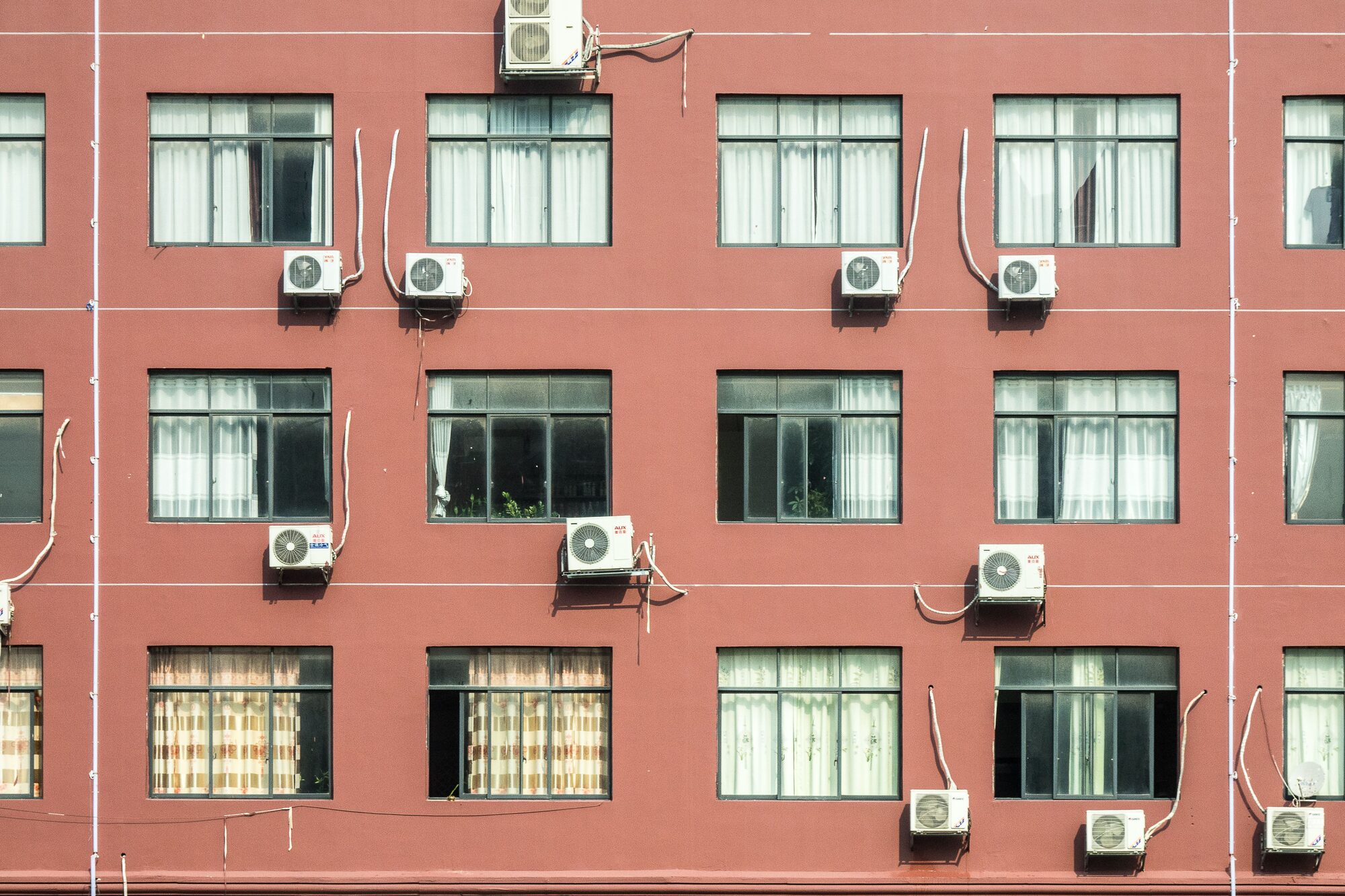
Photo: Air conditioning units on an apartment façade. Credit: Mike van Schoonderwalt via Pexels.
Heat exposure cost the world 573 billion potential working hours in 2025 and US$1.07 trillion in lost income. The obvious response is to cool buildings. But cooling runs on electricity, generates waste heat into the street, and in most grids still burns fossil fuel — so the remedy feeds the condition. The hard part of urban climate policy is not choosing between heat and cooling. It is breaking the loop between them.
What heat already costs
Start with the bill, because it is larger than most planning documents assume.
The Lancet Countdown’s latest assessment puts global losses from heat exposure at 573 billion potential work hours in 2025, equivalent to US$1.07 trillion in income, with low- and middle-income countries most affected. The same work attributes more than half a million deaths a year to heat between 2016 and 2023, of which it estimates 68% would not have occurred without climate change [1].
The International Labour Organization reached the same place from the labour side. Its projection — made on the deliberately conservative assumption that warming stops at 1.5°C, and that agricultural and construction work happens in shade — is that 2.2% of all working hours will be lost to heat stress by 2030. That is 80 million full-time jobs and US$2,400 billion. Agriculture absorbs about 60% of the loss and construction 19%. Southern Asia and western Africa lose around 5% of working hours, some 43 million and 9 million jobs respectively [2].
Both figures describe the same thing: heat is already a macroeconomic variable, not a weather inconvenience.
The city-scale number
For urbanists the more useful arithmetic is local, and the Adrienne Arsht-Rock Resilience Center produced it by costing heat-related productivity losses across twelve cities.
Those twelve lose about US$44 billion in an average year, rising to US$84 billion by 2050 without emissions reductions [4]. The headline, though, is the spread. Losses run from 0.1% of economic output in Santiago to 8.3% in Dhaka, with Bangkok at 4.9%, New Delhi at 4.2% and Freetown at 3.5%. Dhaka’s share is projected to reach around 10% of city GDP by 2050. New Delhi’s loss rises to almost 5%, about US$6.1 billion. Miami already loses more than US$10 billion a year and could lose more than US$20 billion by 2050 [3].
Two features of that distribution matter. The losses concentrate in sectors built on outdoor manual work, where wages are already below average — so heat functions as a regressive tax. And the cities carrying the largest proportional losses are the ones with the least fiscal room to adapt.
The cooling loop
Faced with that bill, cities buy cooling. The scale of what follows is the part worth sitting with.
The International Energy Agency’s assessment of global cooling projected the world’s stock of air conditioners rising from about 1.6 billion units to 5.6 billion by 2050 — an average of roughly ten units sold every second for thirty years — with demand tripling over the same period. By 2050 cooling is projected to account for between a quarter and nearly half of peak electricity load in the United States, the Middle East, Indonesia, India and Brazil [5].
That last figure is the one that breaks grids. Peak load is what generation capacity is sized for, and a demand curve dominated by cooling peaks precisely when solar output is falling and everyone is home.
The growth is also, in one sense, a story of justice rather than excess. Around 2.8 billion people live in the hottest parts of the world, and only about 8% of them have air conditioning at home, against more than 90% of households in Japan and the United States [5]. The people most exposed to dangerous heat are the ones least able to escape it. Nobody sensible argues they should stay that way.
But the loop is real. Cooling consumes electricity, which in most grids still means combustion. It rejects waste heat directly into the street, raising outdoor temperatures for everyone without a unit. And it runs on refrigerants — hydrofluorocarbons — that are harmless to the ozone layer but potent greenhouse gases in their own right.
Each household that cools itself makes the street outside marginally hotter for the household that cannot.
The urban heat island multiplies the bill
Cities do not experience the global average. They run hotter, and the premium shows up directly on the electricity meter.
Work by Mi Aye Su, Jack Ngarambe, Mat Santamouris and Geun Young Yun, using measured building energy data rather than simulation, found that a change in average urban heat island intensity of just 0.5 K corresponds to additional monthly cooling consumption of between 0.17 and 1.84 kWh per square metre [6].
Read that as a planning statement rather than a physics one. The same building, in the same climate, costs materially more to cool because of what has been built around it — the albedo of the surfaces, the absence of trees, the geometry of the street canyon, the waste heat of neighbouring systems. Urban form is an energy specification whether or not anyone writes it down as one.
It is also why demand-side efficiency alone will not hold. A more efficient air conditioner in a hotter street is still a growing load.
Where the loop can be cut
Three leverage points, in ascending order of difficulty and of payoff.
The equipment. This is the easy one and it is being done. The Kigali Amendment to the Montreal Protocol, adopted in 2016, phases down HFC production over three decades; UNEP estimates that avoids around 0.5°C of warming by 2100, and that pairing the phase-down with efficiency improvements in the equipment itself could roughly double that — to something near 1°C. The efficiency gap is embarrassing rather than technical: many air conditioners already on sale are more than twice as efficient as the ones actually being bought [7]. Minimum performance standards and labelling close that gap with a stroke of regulation, and remain the cheapest climate policy available to most governments.
The building. Orientation, shading, thermal mass, cross-ventilation, roof treatment and glazing ratio decide how much cooling a building needs before any equipment is specified. These are design decisions, they cost little at the drawing stage and a fortune to retrofit, and they are routinely value-engineered out. The recently published rebuild of Kinshasa’s central market is one demonstration that an 82,000 m² public building in an equatorial city can be run on section and mass rather than on plant.
The city. Albedo, canopy cover, street geometry and the spacing of buildings set the baseline that every building inside the city must work against. This is the slowest lever and the one with the widest reach — and, unlike the other two, it also protects the people who will never own an air conditioner. A shaded bus stop, a tree-lined footpath and a cool roof on a workshop are heat policy for the 92%.
What planners should take from the numbers
Put heat in the economic case, not the environmental annexe. Productivity loss at 4–8% of city output is not a sustainability footnote; it is a competitiveness argument, and it belongs in the same document as transport benefit-cost ratios. The Arsht-Rock figures exist precisely so that cities can make that argument.
Treat cooling as infrastructure with a demand curve. Cooling at a quarter to a half of peak load is a utility planning problem, not an appliance choice. Urban heat island mitigation is therefore a grid investment, and should be funded like one.
Write outdoor thermal comfort into standards. Indoor comfort is regulated; the street is not. Yet the losses concentrate among outdoor workers, who have no thermostat. Shade provision, water, and heat-triggered work rules are the cheapest interventions in this entire field and almost nowhere mandatory.
Measure the island, not just the region. Regional climate projections are too coarse to govern a street. If a 0.5 K difference in heat island intensity moves building energy use measurably, then canopy cover and surface albedo are operational metrics, and should be monitored with the same seriousness as air quality.
The honest position
Air conditioning is not the villain. Denying cooling to the 2.8 billion people living in the hottest places, almost none of whom have it, would be both unjust and politically impossible, and the health case for mechanical cooling during extreme events is unambiguous.
The argument is narrower and more awkward. If cooling is the only instrument a city has, demand grows without limit, the grid is sized for the worst hour of the worst day, the street gets hotter, and the people outside it — the ones already losing 573 billion hours of work — are left exactly where they were.
Cooling the inside of buildings is a private good that cities have allowed to substitute for a public one. The public one is a cooler city, and it is built from trees, surfaces, geometry and shade rather than compressors. It is slower, less visible, and the only version that reaches everyone.
Connect with the author, Asesh Sarkar, on LinkedIn, and follow Urban Frontier Insights on LinkedIn.
References
[1] Lancet Countdown on health and climate change, reported by ABC News (2026). Global Lancet study counts almost 3 million climate change-related deaths.
[2] International Labour Organization (2019). Working on a warmer planet: the impact of heat stress on labour productivity and decent work.
[3] Adrienne Arsht-Rock Resilience Center & Vivid Economics. Hot Cities, Chilled Economies.
[4] Adrienne Arsht-Rock Resilience Center. The cost of extreme heat.
[5] International Energy Agency, The Future of Cooling, reported by Solarthermalworld (2018). Global electricity demand for air conditioning to triple by 2050.
[6] Su, M. A., Ngarambe, J., Santamouris, M., & Yun, G. Y. (2021). Empirical evidence on the impact of urban overheating on building cooling and heating energy consumption. iScience, 24(5), 102495.
[7] UN Environment Programme (2025). How a pact to protect the ozone layer is helping counter climate change.
Write for UFI
Have a story about cities? We publish articles and photo essays from researchers, practitioners and photographers.
Pitch us at contact@urbanfrontierinsights.com