
Photographs © Neil Wildin
For almost forty years, I’ve taken photographs. Here I reflect on the creative pleasure, memory and learned instinct behind the urge to take one.
Words and photographs by Neil Wildin · Salisbury · Munich · Brazil · 7 November 2026
I was about ten years old when my parents gave me my first camera for Christmas. It was a basic film camera, the sort where you loaded a roll of film, took your pictures and waited for them to be developed before discovering whether any of them had worked.
The first photograph I took was of my family. I remember asking everyone to stand against the wall so I could take their picture. There was nothing particularly unusual about it. I’d just unwrapped a camera, there were people in the room, and I wanted to try my new present.
I still have that photograph in my archive.
What I don’t know is why my parents chose a camera. They could have given me a toy or a book, or any number of things a boy of that age might have enjoyed. Perhaps one of them had noticed me looking at my father’s camera. Maybe I’d asked questions about it. I simply don’t remember.
My brother and sister were never given cameras, as far as I recall. Somebody made a conscious decision to buy one for me, although I never asked what prompted it.
For almost forty years, I’ve kept taking photographs. The cameras have changed, the subjects have changed, and I’ve become considerably more experienced. What hasn’t disappeared is the enjoyment I get from making an image.
Until recently, I hadn’t given much thought to why.
An unexpected question
On 1 November 2026, I was searching for my name online when I came across an old photography website belonging to another British photographer, Chris Broadhurst.
Chris had experimented with high dynamic range photography, or HDR, a technique that combines exposures to preserve detail across a wider range of light and shadow than a single exposure might ordinarily capture.
One of his pages examined photographs of the nave of Salisbury Cathedral. He had photographed the interior himself and experimented with several processing methods. During that work, he’d found a photograph I had taken from almost the same position and had cropped the two images to make them comparable.
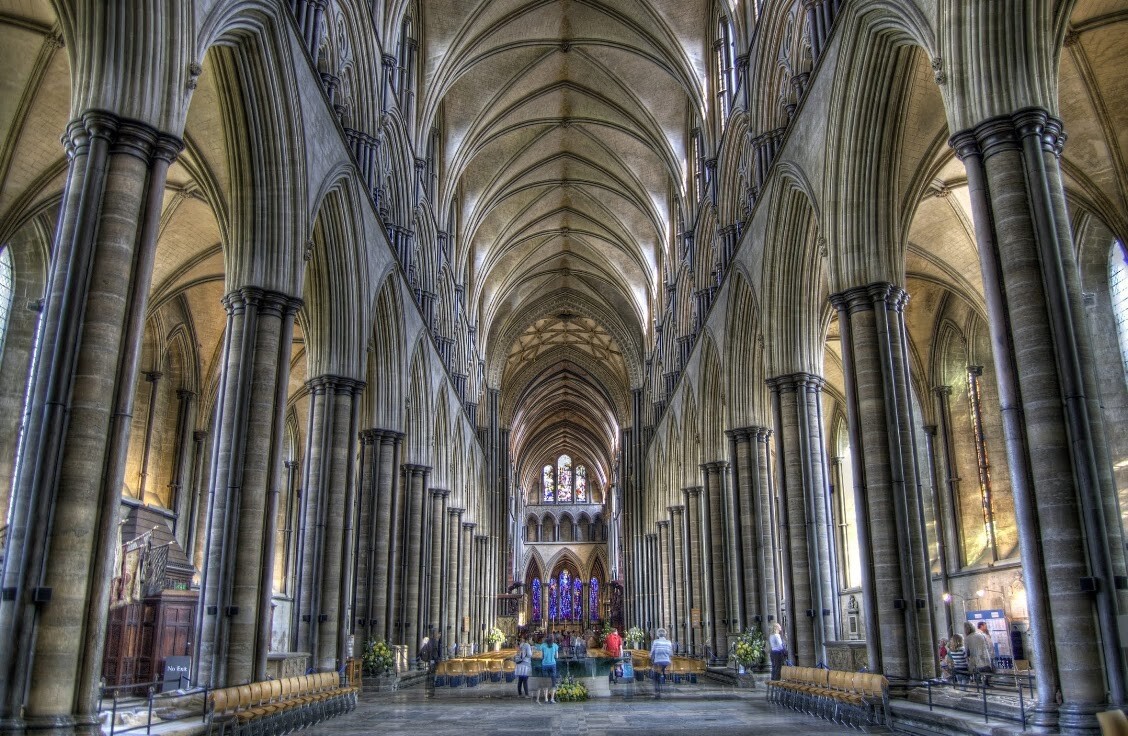
I recognised the photograph immediately. It belonged to a period when I’d taken a year away from my regular career to concentrate on photography, including commercial work involving cathedrals and abbeys.
I contacted Chris, and we began exchanging emails.
He told me he had moved on from photographing churches. His current interest involved using handheld light to photograph objects and people, giving him considerable control over how the subjects appeared. He described the process as addictive.
Then he wrote:
I wish I understood why we are driven to capture images.
I thought about that for a moment.
In my reply, I told him that photography stimulates the creative part of my brain. I find that satisfying. I enjoy it.
That was my immediate answer, and I still think it’s a reasonable one. But Chris had asked something slightly different. He wasn’t simply asking whether photography was enjoyable. He wanted to understand the urge to capture an image in the first place.
Why isn’t seeing something enough?
The photograph I’ve already taken
My wife and I were recently travelling in Munich and Barcelona, where we visited Marienplatz and the Sagrada Família.
Both are impressive places, although they’re also familiar examples of what happens when large numbers of tourists gather in front of famous buildings. People stop, raise their phones and photograph whatever stands directly ahead of them.
There’s nothing wrong with that. They’re recording their visit, which is often precisely what they want.
But in both locations I could see a composition that interested me more than the obvious frontal view.
Within seconds I’d worked out where I wanted to stand, what I wanted inside the frame and how the building should relate to its surroundings. I took one photograph at each location, using my iPhone, and was pleased with both results.
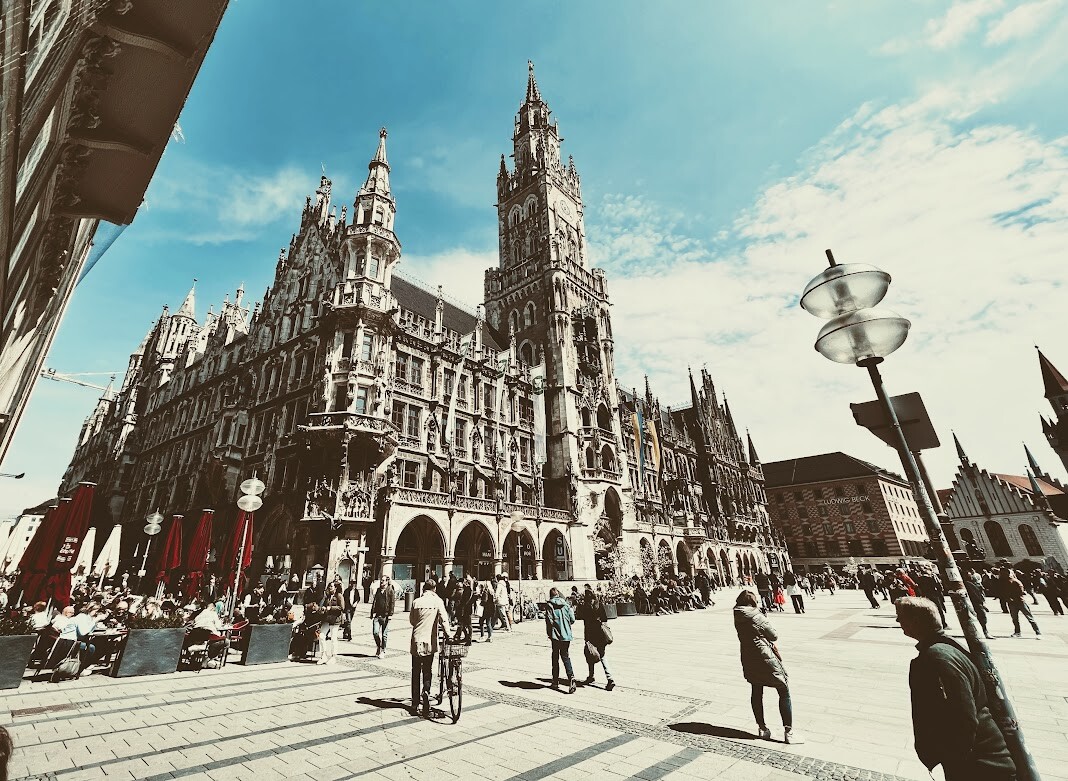
My wife has asked how I manage to recognise these viewpoints so quickly.
I generally tell her that it comes from experience. When I was photographing cathedrals and abbeys, I spent considerable time experimenting with composition, moving around buildings, comparing viewpoints and learning what worked. Gradually, decisions that once required deliberate thought became instinctive.
On another occasion, when she asked whether I had already imagined the finished photograph, I gave her an answer that probably describes the process better.
I’ve already taken the mental photo. Now I just have to take the physical one.
I wasn’t suggesting that I possessed some unusual ability. I meant that, before pressing the shutter, I already knew roughly what I wanted the photograph to look like.
I don’t stand in front of a building consciously calculating every line and angle. I look at it, recognise a possible composition and move into position.
It’s something I’ve learned to do through practice, although I sometimes wonder how much of that recognition is learned and how much comes naturally.
Ansel Adams described a related process as visualisation: anticipating the completed photograph before making the exposure. John Szarkowski’s The Photographer’s Eye (1966) examined how photographers make choices about the frame, viewpoint, detail and moment of exposure.
I recognise those ideas in my own practice. What I can’t establish is precisely how the accumulated experience becomes an apparently instantaneous decision.
The Munich photograph illustrates another part of the process.
Although the New Town Hall is the most obvious subject, I wasn’t particularly interested in producing an isolated architectural photograph. I wanted the square as we experienced it, including the people, the movement and the general activity taking place around the building.
In some ways, I didn’t care about the building itself. I cared more about the experience.
A technically accomplished photograph of an empty square might have been attractive, but it wouldn’t necessarily have recorded what I wanted to remember about that visit.
This distinction between recording a subject and recording an experience has become increasingly important to me.
Knowing when to take the camera out
I don’t generally walk around a city searching for photographs.
When my wife and I travel, we’re there to enjoy ourselves, explore somewhere unfamiliar and spend time together. Photography is something I do along the way.
Occasionally I’ll see something and recognise the possibility of a picture. I may not even have been thinking about photography a moment earlier. Nevertheless, the composition forms in my mind, I take out my phone, take the photograph and put it away again.
I’m perfectly happy to leave it there.
I don’t need to take another hundred photographs to justify having the camera with me. If I’ve captured what I wanted, I’m satisfied.
But something changes once I’ve recognised the potential image.
At that point I do feel an urge to take the photograph, and I’m quite determined to capture what I’ve mentally envisaged.
Perhaps that is the distinction Chris was getting at.
I don’t feel a constant need to photograph everything around me. Yet when a particular image presents itself, I want to turn it into something tangible.
Sometimes I can’t.
A bus might obstruct the view. The light might change, someone might move, or the position I need might be inaccessible. I’ve encountered these problems over the years, although relatively few have remained memorable.
I don’t look back at the missed opportunities with disappointment.
Life is a constantly moving object, if you like. Circumstances change, and there’s little point treating something outside your control as a personal failure.
There are also occasions when I deliberately go looking for particular photographs.
For example, my wife and I have planned a drive to some lakes, and I’ve decided to take my camera to explore an idea I’ve been calling The Geometry of Stillness.
I’m interested in the lines that occur naturally within a landscape and what happens when man-made structures introduce their own geometry. I want to examine the relationships between them without including people in the compositions.
I’ve already imagined some possibilities, but I haven’t visited the location. I don’t know what the light will be doing, whether the viewpoints will be accessible or whether the landscape will support the idea at all.
I could return with perfectly good photographs that nevertheless fail to express the concept.
That wouldn’t particularly trouble me. We’re going for a drive, spending time together and visiting somewhere new. Photography is an additional reason to go, not the only reason.
If the concept doesn’t work, the experience may suggest another direction.
I don’t regard that as taking bad photographs. It’s the difference between making a good image and successfully exploring a particular idea.
The pleasure of making things
I’ve always enjoyed creative activities.
As a child I liked drawing, although I don’t do much of that now. I’ve enjoyed building models, making things from wood and solving practical problems. There’s satisfaction in looking at something that needs doing, working out how to do it and producing a result.
Writing has been another longstanding interest.
I remember being seven or eight years old and receiving school assignments that required us to write a short story. Sometimes I’d develop the idea so far beyond the original exercise that I had to ask for another notebook. What was intended to be a one-page story could turn into twelve pages because I wanted to finish what I’d started.
Nobody had asked me to write that much. I simply enjoyed developing the story.
I see something similar in photography, although I wouldn’t claim that all creative activities feel identical.
When I’m building a model or making something from wood, I have an idea of what I want to produce. I work towards it, make adjustments and solve problems as they arise.
Photography allows me to complete a comparable process much more quickly.
With modern digital photography, the time between recognising an image and seeing the result can be a matter of seconds. I take the photograph, look at the screen and think, brilliant, that’s nice.
Then I move on.
There’s gratification in knowing that I’ve used my judgment and technical ability to achieve something I’d already imagined.
Psychologists use the term intrinsic motivation to describe activities undertaken because the activity itself is rewarding. It seems relevant here, particularly because my enjoyment of photography has never depended entirely on professional success or recognition.
From late 2011 to mid-2012, I took about a year away from my regular career to concentrate on photography. I worked with cathedrals and abbeys, developed my skills and pursued commercial opportunities.
Then I returned to my full-time career.
My dedicated camera spent much of the next fourteen or fifteen years unused, but I continued taking pictures with my iPhone whenever we travelled.
I wasn’t publishing them regularly or attempting to build a photographic career. I wanted the pictures for myself, for the enjoyment of taking them and for the memories they preserved.
That seems reasonably strong evidence that the interest was never entirely professional.
Robert Adams explored the personal motivations behind photography in Why People Photograph (1994). His essays consider a range of reasons photographers continue working, many of which extend beyond earning a living or producing images for an audience.
I can’t speak for his motivations, or for those of other photographers. In my own case, the satisfaction of making something appears to be a substantial part of the answer.
Looking, observing and looking again
I spend time looking through my photographic archive.
Sometimes I scroll back through my archive and find pictures taken during a particular journey. I recognise the location, remember the circumstances and occasionally recall details that hadn’t occurred to me for a long time.
This was one of the reasons I wanted the Munich photograph to contain more than the architecture.
I wanted a record of the square as we experienced it.
But photographs have another useful characteristic. They allow me to examine details after the original encounter has ended.
I’ve sometimes looked at an old picture and noticed something that escaped my attention when I took it.
That interests me because it connects with questions I’ve been developing in VISUS, the second volume of my wider writing project about how we see the world.
One of the subjects in VISUS is the distinction between looking and observing. Another is the value of looking again.
In practice, we don’t always have the opportunity to do that while standing in front of something.
We’re travelling, walking through a crowded street, watching an event or moving between places. We might only have a few seconds to notice something before the situation changes.
The photograph gives us an opportunity to return to a particular view and examine it more carefully.
Of course, the photograph isn’t the original experience. It contains only what was included within the frame at the instant of exposure. Everything beyond that boundary has been excluded, and the image cannot reproduce the complete movement, sound or atmosphere of the place.
Nevertheless, the recorded details remain available for examination.
This relationship between photography, attention and memory has received some experimental attention.
Diehl, Zauberman and Barasch (2016) found that taking photographs could increase people’s enjoyment of an experience, partly because the act of photographing encouraged greater visual engagement.
Linda Henkel’s research (2014) complicates that picture. In a study involving museum visitors, photographing objects was associated with poorer subsequent memory under certain conditions. That effect was not observed in the same way when participants photographed particular details.
These findings don’t tell us exactly what happens when I photograph a cathedral or a crowded city square. They do suggest that the relationship between photographing something and remembering it is more complicated than simply assuming the camera improves memory.
My experience is fairly straightforward.
Sometimes I take a picture, it captures what I intended, and there’s nothing more to say about it.
At other times I return years later, notice something I hadn’t previously seen and find the photograph interesting for an additional reason.
I like having that possibility available, whether or not I make use of it.
My father’s camera
There’s a black-and-white photograph of me as a child, sitting in the garden of the house where I grew up.
My father took it.
I think it’s a very good photograph. The composition is well judged, the lighting works, and the result has the qualities I’d look for in a portrait today.
What makes it interesting is that my father was hardly an enthusiastic photographer.
I remember him buying a camera and keeping it in a cupboard for years. It wasn’t something he used regularly. He may have taken photographs on only a handful of occasions.
Yet he was capable of producing an image like that.
My uncle now spends considerable time photographing wildlife. As far as I know, this is an interest he’s developed relatively recently, and I only became aware of it as an adult. It certainly wasn’t an influence on my childhood interest in photography.
Nevertheless, seeing these examples within the family has made me wonder whether some element of photographic aptitude might be inherited.
Research into creativity has identified genetic and environmental contributions to individual differences, although the findings depend partly on what is being measured. Kandler and colleagues (2016), for example, examined relationships between creativity, personality, cognitive ability and environmental influences using twin data.
That research cannot establish whether I inherited a photographic eye from my father, and I wouldn’t pretend that it could.
We have one surviving photograph I particularly admire, a camera that was seldom used, and my own recollections of growing up.
It isn’t much evidence on which to construct a genetic explanation.
Still, the contrast interests me.
My father could take a photograph that I consider accomplished without apparently feeling much desire to keep taking photographs. I developed an interest that has remained with me for decades.
Perhaps an aptitude for recognising good images and the motivation to make them are different characteristics.
Perhaps they are related.
I don’t know.
And I still don’t know why my parents chose to give me a camera for Christmas when I was ten.
Adding words to photographs
My photography has taken another direction since moving to Brazil.
Recently, I began photographing political demonstrations, including a rally connected with President Lula.
I went because I wanted to take photographs. I was interested in the people, the activity, the compositions and the possibility of capturing something worthwhile.
The idea of becoming a photojournalist emerged afterwards.
Having taken the photographs, I decided to write about the event and explain what was happening. I enjoyed putting the words together, and the combination of photography and writing seemed worth developing.
That led to the creation of Wildin.com.br, where I’ve begun publishing photographs and accompanying essays.
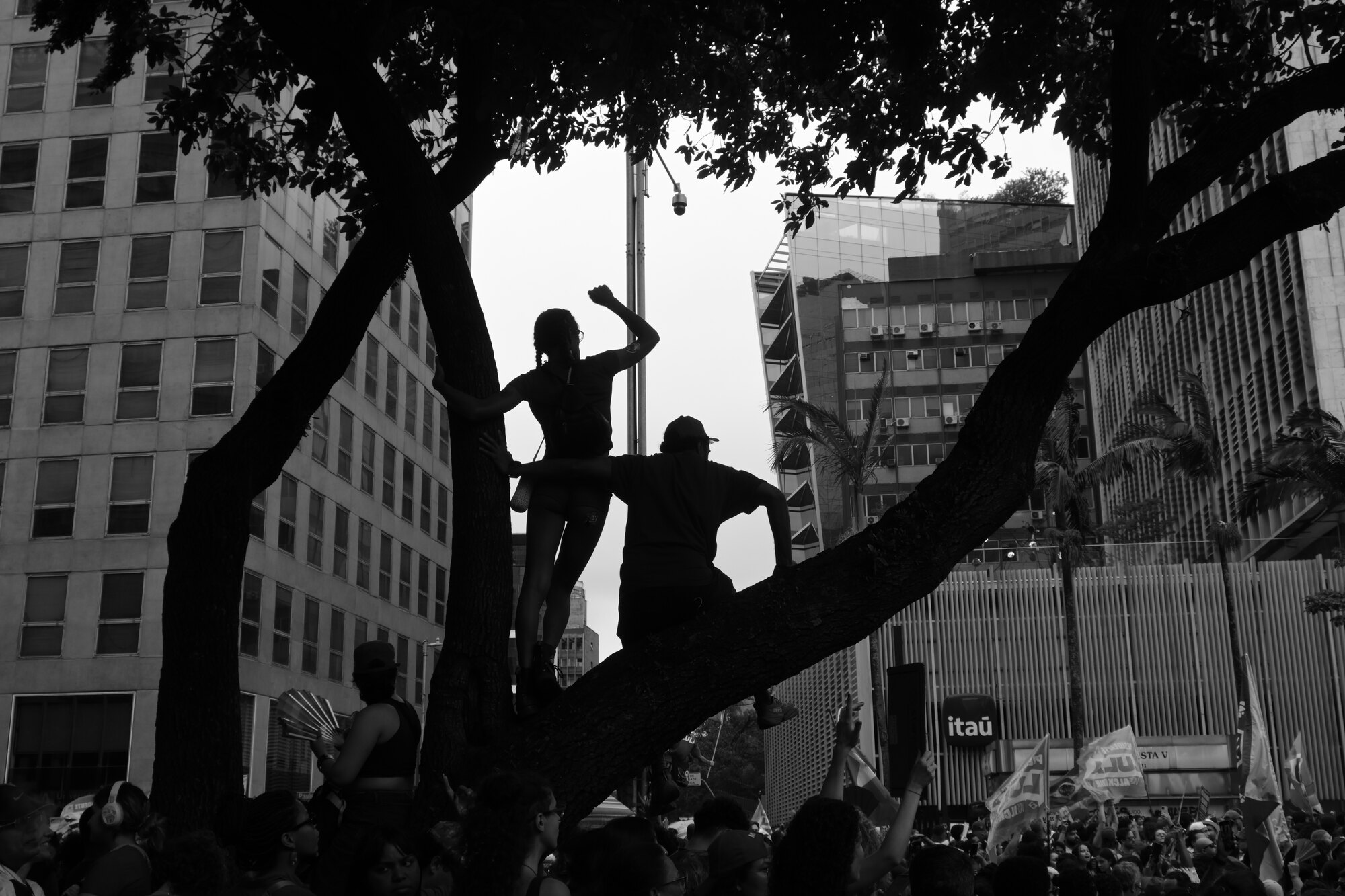
The distinction matters because I didn’t set out with a professional plan to become a photojournalist and then begin searching for images to support it.
I enjoyed taking photographs. I enjoyed writing about them. The combination developed into something that could be published.
Once published, the photographs acquire an additional purpose. Political events are relevant to the people involved, the circumstances in which they occur and the historical record. The writing helps establish that context.
But those considerations came after my initial interest in photographing the event.
That sequence may change as I gain more experience in photojournalism. I may eventually approach particular subjects with a story already in mind. For now, I can only describe how it began.
It’s also worth distinguishing my satisfaction in making an image from the response it receives.
I enjoy it when somebody compliments a photograph, although I don’t seek approval.
If I think an image is good, I’m usually confident other people will appreciate it too, even if they don’t recognise the technical decisions that produced it.
A photographer may notice the perspective, framing or quality of light. Somebody else may simply like the subject.
Others might look briefly and move on.
People bring different experiences and expectations to photographs, and I’m comfortable with that.
My own judgment of the picture has generally been made long before anybody else sees it.
The urge to capture
Chris’s question has led me through rather more of my photographic history than I expected when I first read his email.
I’ve considered the camera my parents gave me, the experience I gained photographing cathedrals, the pictures I take while travelling, my wider interest in creative work and the recent development of photography into photojournalism.
There are several possible explanations for why I enjoy the activity.
The satisfaction of creating something is one. The ability to preserve an experience is another. There’s also the pleasure of recognising an attractive composition, applying a skill I’ve developed and producing an image that looks the way I intended.
Sometimes I enjoy the prospect of sharing the result, although that isn’t essential.
Susan Sontag examined photography’s relationship with experience in On Photography (1977), while Roland Barthes explored photographs, memory and personal attachment in Camera Lucida (1980).
Both provide ways of thinking about why photographs matter, particularly after they have been made.
But I keep returning to the moment before pressing the shutter.
I’m walking through a city, enjoying the surroundings, when something catches my attention. I recognise a photograph, often without consciously working through the composition.
Within a few seconds I’ve already formed the image in my mind.
And at that point I want to capture it.
That urge is real enough, even though I can accept it when circumstances prevent me from succeeding.
I don’t think it arises from a constant need to document everything. Nor do I think it can be explained entirely by memory, aesthetics or the pleasure of receiving compliments.
It may be connected with the same creative inclination that made me draw pictures, build models, work with wood and ask for extra notebooks at primary school.
But photography has qualities those other activities don’t possess. It allows me to recognise something in the world, make decisions about it and produce a lasting image almost immediately.
The world provides the material. I decide what to do with it.
I’m reasonably confident about why I enjoy that process. I’m less certain about why the desire to make the image occurs in the first place.
Perhaps the distinction between learning to recognise a photograph and wanting to capture it deserves further examination. One concerns ability, the other motivation, and I don’t yet know how closely they’re connected.
Chris is now making photographs using handheld light, controlling the way his subjects appear. I’m exploring streets, architecture, political events and landscapes, often working with whatever conditions happen to be available.
We’re doing different things with our cameras, but we both appear to find the process sufficiently rewarding to continue.
I suspect the explanation varies between photographers, and perhaps between photographs.
I can tell Chris what I experience when I see an image I want to make. I can describe the satisfaction when I capture it successfully, and the pleasure of returning to it years later.
What I can’t do is identify a single cause that explains all of it.
My father took a black-and-white portrait that I still admire, then apparently left his camera in a cupboard for years. My parents gave me a camera for reasons I no longer have any way of establishing. I took a photograph of my family that Christmas Day and have continued taking pictures ever since.
The photographs are there. Some of the circumstances remain clear in my memory.
The original question remains rather less straightforward.
And I think that’s worth exploring further.
About the author
Neil Wildin is an independent documentary photographer based in Brazil. His work can be seen at wildin.com.br.
References and further reading
[1] Adams, R. (1994). Why People Photograph: Selected Essays and Reviews. Aperture.
[2] Barthes, R. (1981). Camera Lucida: Reflections on Photography. Hill and Wang. Originally published in French in 1980.
[3] Broadhurst, C. (n.d.). HDR image experiments: Salisbury Cathedral nave. http://www.broadhurst-family.co.uk/lefteye/MainPages/hdr.htm
[4] Diehl, K., Zauberman, G., & Barasch, A. (2016). How taking photos increases enjoyment of experiences. Journal of Personality and Social Psychology, 111(2), 119–140. https://doi.org/10.1037/pspa0000055
[5] Henkel, L. A. (2014). Point-and-shoot memories: The influence of taking photos on memory for a museum tour. Psychological Science, 25(2), 396–402. https://doi.org/10.1177/0956797613504438
[6] Kandler, C., Riemann, R., Angleitner, A., Spinath, F. M., Borkenau, P., & Penke, L. (2016). The nature of creativity: The roles of genetic factors, personality traits, cognitive abilities, and environmental sources. Journal of Personality and Social Psychology, 111(2), 230–249. https://doi.org/10.1037/pspp0000087
[7] Sontag, S. (1977). On Photography. Farrar, Straus and Giroux.
[8] Szarkowski, J. (1966). The Photographer’s Eye. Museum of Modern Art.
[9] Wildin, N. (2026). VISUS: Volume II, working manuscript. Unpublished.
[10] Personal source: Email correspondence between Neil Wildin and Chris Broadhurst, 1 November 2026.
Write for UFI
Have a story about cities? We publish articles and photo essays from researchers, practitioners and photographers.
Pitch us at contact@urbanfrontierinsights.com