
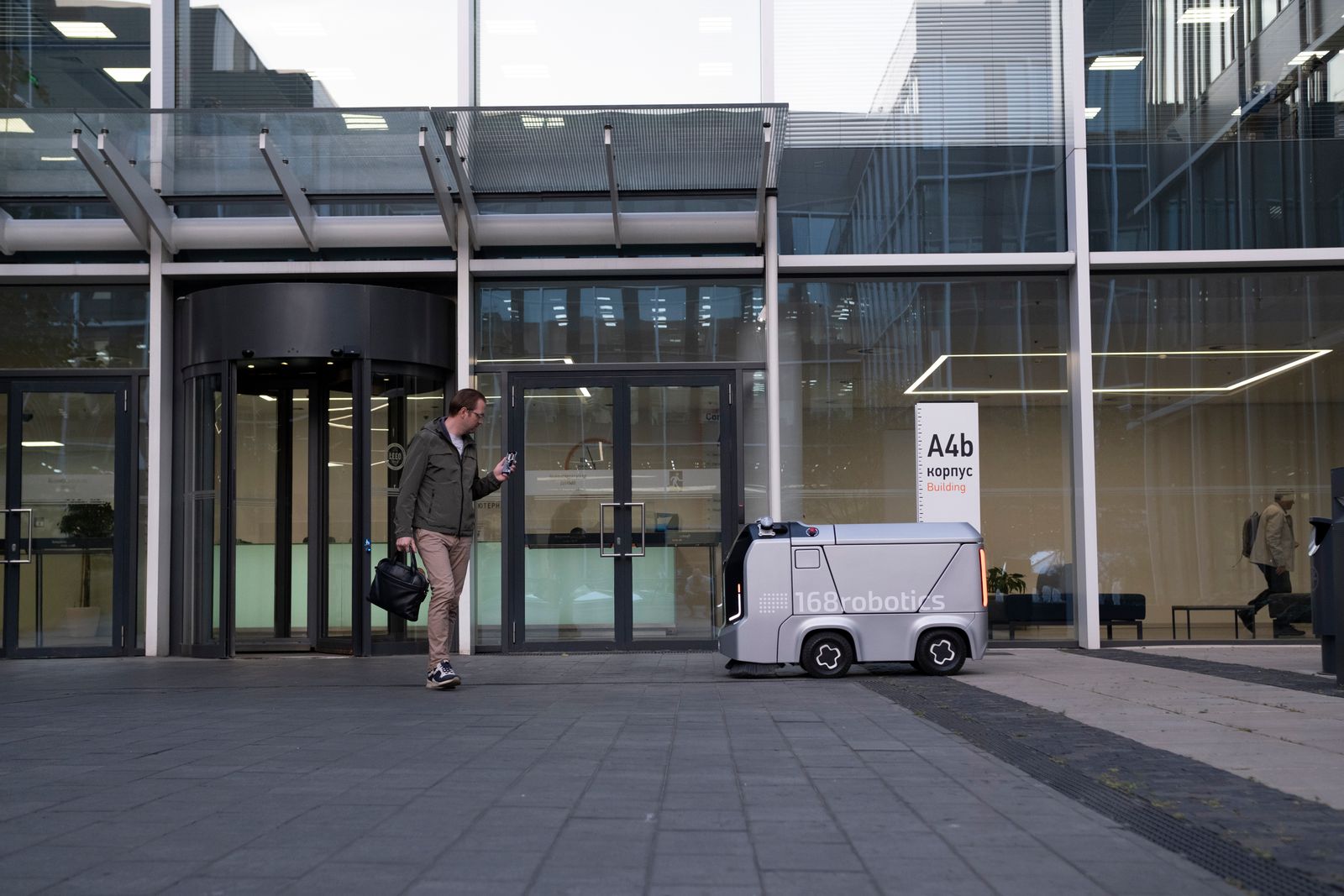
For most of the past decade, artificial intelligence lived on screens. It recommended films, translated text and, more recently, began writing essays. That is changing. A new wave of physical AI — systems that learn how the physical world works and act within it — is moving into streets, factories, homes and hospitals. Analysts at In-Q-Tel define its core capability as “generalizable physical reasoning” [1], and at CES 2025 NVIDIA launched Cosmos, a platform of “world foundation models” built to train robots and autonomous vehicles on simulated physics [2]. For cities, the question is no longer whether these machines will arrive, but on whose terms.
From screens to streets
Physical AI is already operating at urban scale. In March 2026, Waymo reported 500,000 paid driverless rides a week across ten US cities [3]. Factories installed 542,000 industrial robots in 2024, roughly double the annual figure of a decade earlier, bringing the global operating stock to 4.66 million; China accounted for 54% of installations, while India added 9,100 [4]. Warehouses, construction sites, hospitals and pavements are next, with delivery robots, inspection drones, street-cleaning machines and, increasingly, humanoids. Unlike a chatbot, a machine that moves through a city shares space with people — and its mistakes are physical.
Mobility: safety gains, planning puzzles
Mobility is where physical AI is most visible. A peer-reviewed analysis of 56.7 million rider-only miles found that Waymo’s vehicles were involved in significantly fewer injury-causing and serious-injury crashes than human-driven benchmarks, with the largest reductions at intersections and fewer injury crashes involving pedestrians and cyclists [5]. Those are real gains. But autonomy does not automatically produce better cities. Cheap, comfortable robotaxis could draw riders away from buses and metros, add empty “deadheading” kilometres and intensify congestion unless they are integrated with public transport, priced for road use and governed by clear rules for kerb space. In Indian cities, where streets are shared by pedestrians, street vendors, two-wheelers and informal transport, the design challenge is even greater. Planners need to decide how autonomous fleets will share streets with walking, cycling and transit before the vehicles arrive, not after.
Environment: a heavy footprint and a smart one
Physical AI rests on energy-hungry computing. The International Energy Agency estimates that data centres used about 415 TWh of electricity in 2024, around 1.5% of global consumption, and projects this to more than double to roughly 945 TWh by 2030 [6]. Robots, sensors and charging fleets add to that load, and to the demand for minerals and the stream of electronic waste. Yet the same capabilities can make urban systems leaner: sensors that detect water leaks, robots that sort recyclables, and controls that balance the energy use of buildings and grids. The environmental case for physical AI is conditional. It must run on clean power and be deployed where it saves more than it consumes.
Governance and city planning
Cities are already becoming sensing platforms. Under India’s Smart Cities Mission, all 100 smart cities run Integrated Command and Control Centres that support traffic monitoring and waste-collection tracking, and the mission has installed more than 83,000 CCTV cameras for public safety [7]. Add AI-powered perception and the same infrastructure could optimise signals and emergency response — or enable pervasive surveillance. AI is also entering plan-making itself, through digital twins that simulate floods and heat and tools that screen building permits. UN-Habitat and Mila warn that deploying AI in cities without proper governance or regard for human rights can have “negative, even catastrophic, effects”, and call for a people-centred digital transformation [8]. For planners, this means treating data, algorithms and robots as urban infrastructure, subject to public procurement standards, impact assessments, independent audits and citizen participation, just as roads and drains are.
Regulation: different paths
The European Union’s AI Act, in force since August 2024, bans certain practices outright, such as social scoring, and imposes strict duties, including human oversight, on “high-risk” systems [9]. Its timetable has shifted: the 2026 Digital Omnibus, Regulation (EU) 2026/1744, postponed obligations for standalone high-risk systems to December 2027 and for AI embedded in regulated products, such as machinery, to August 2028 [10][11]. India has chosen a lighter route. Its AI Governance Guidelines, released by the Ministry of Electronics and Information Technology in November 2025, set out seven principles — among them “People First” and “Innovation over Restraint” — and rely on existing laws rather than a dedicated AI statute for now [12]. Neither approach yet answers the questions cities face most directly: who is liable when a delivery robot injures a pedestrian, who owns the data that sensors collect on public streets, and how local governments can set the terms of deployment.
Human–AI interaction and trust
Living alongside machines that move is a social question as much as a technical one. Public trust varies widely: in Stanford’s 2026 AI Index, trust in government to regulate AI ranges from 91% in Singapore to 31% in the United States, while India ranks among the countries with the highest trust in AI [13]. That trust has to be earned through design — robots and vehicles that signal their intentions clearly, systems that keep a human accountable for every decision that matters, and interfaces that work for older people, children and persons with disabilities.
Wellbeing: efficiency is not enough
The deepest question is what physical AI does to everyday life. Automation can remove dangerous and degrading work and give time back to people. But cities are also where people meet, and if errands, deliveries and journeys become frictionless and solitary, we risk designing out the casual encounters that sustain social connection. That is not a small risk: the World Health Organization estimates that one in six people worldwide is affected by loneliness, which is linked to more than 871,000 deaths a year [14]. Research on Indian cities shows that the social environment — community spaces, inclusive public spaces and opportunities for interaction — matters for mental well-being [15], and recent work has examined how the quality of and access to green spaces relate to loneliness [16]. Physical AI should be judged by whether it frees up time and space for human connection, not only by how many trips or tasks it automates.
Is it our future?
Yes — partly, and unevenly. Physical AI will be part of the urban future; it is already part of the urban present. But the future it builds is not determined by technology. It depends on choices made in master plans, mobility policies, procurement rules and regulation: whether autonomous vehicles feed public transport or compete with it, whether city sensors serve residents or watch them, whether robots relieve workers or simply replace them, and whether the energy that powers them is clean. The task for planners and designers is to set those terms deliberately, so that intelligent machines serve the city rather than the city being redesigned around them.
References
1. Waite, R., & Golota, N. (2026, February 4). What is physical AI? A definition and framework. In-Q-Tel. iqt.org
2. Elgan, M. (2025, January 17). Robots get their ‘ChatGPT moment’. Computerworld. computerworld.com
3. Korosec, K. (2026, March 27). Waymo’s skyrocketing ridership in one chart. TechCrunch. techcrunch.com
4. International Federation of Robotics. (2025, September 25). World Robotics 2025 – Industrial Robots [Press release]. Frankfurt: IFR. ifr.org
5. Kusano, K. D., Scanlon, J. M., Chen, Y., McMurry, T., Gode, T., & Victor, T. (2025). Comparison of Waymo rider-only crash rates by crash type to human benchmarks at 56.7 million miles. Traffic Injury Prevention. doi.org/10.1080/15389588.2025.2499887
6. International Energy Agency. (2025). Energy and AI. Paris: IEA. iea.org
7. Press Information Bureau, Government of India. (2024). Smart Cities Mission [Factsheet, Ministry of Housing and Urban Affairs]. pib.gov.in
8. UN-Habitat. (2022). AI & Cities: Risks, Applications and Governance (with Mila – Quebec Artificial Intelligence Institute). Nairobi: UN-Habitat. unhabitat.org
9. European Union. (2024). Regulation (EU) 2024/1689 laying down harmonised rules on artificial intelligence (Artificial Intelligence Act). Official Journal of the European Union, L series, 12 July 2024.
10. European Union. (2026). Regulation (EU) 2026/1744 (Digital Omnibus on AI), amending Regulation (EU) 2024/1689. Overview: artificialintelligenceact.eu
11. Apostle, J. (2026, July 29). EU AI Act update: Digital Omnibus finalizes 8 compliance changes. Orrick. orrick.com
12. Ministry of Electronics and Information Technology. (2025). India AI Governance Guidelines. New Delhi: Government of India. Summary: AZB & Partners
13. Stanford Institute for Human-Centered Artificial Intelligence. (2026). AI Index Report 2026, Chapter 9: Public Opinion. hai.stanford.edu
14. World Health Organization. (2025). From Loneliness to Social Connection: Charting a Path to Healthier Societies. Report of the WHO Commission on Social Connection. Geneva: WHO. who.int
15. Sarkar, A., & Pujara, T. (2025). A conceptual framework for mapping urban environment indicators and mental well-being. Discover Cities, 2(1), 119. doi.org/10.1007/s44327-025-00166-z
16. Sarkar, A., Gemmell, E., P S, S., Anand, S., Bhattacharya, A. A., & Pujara, T. (2026). Perceived quality and access to urban green spaces and loneliness in India. Cities & Health. Advance online publication. doi.org/10.1080/23748834.2026.2686415
Cover image: an autonomous delivery robot on a city street. Photo by Ярослав Сапрыкин (Yaroslav Saprykin) on Pexels.
Write for UFI
Have a story about cities? We publish articles and photo essays from researchers, practitioners and photographers.
Pitch us at contact@urbanfrontierinsights.com