
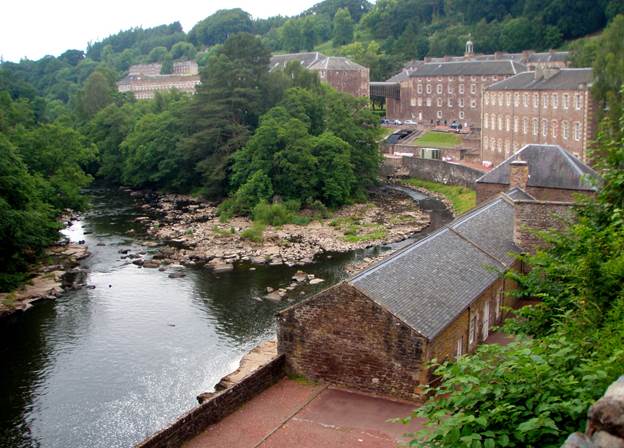
Introduction: When Planning Had Moral Courage
Urban planning today is deeply technical. We debate density thresholds, infrastructure deficits and mobility efficiency. Yet nineteenth- and early twentieth-century urban reformers framed the city not merely as a logistical challenge, but as a moral project.
The experiments of Robert Owen, George Cadbury and Tony Garnier were not naïve fantasies. They were structured, spatially articulated responses to the social crises of industrialization. Their work anticipated contemporary evidence linking the built environment to health, behaviour and social cohesion.
This article revisits these utopian experiments through a research lens and asks: What normative ambition has contemporary planning lost?
Robert Owen and Environmental Determinism
At New Lanark, Owen reduced working hours, improved housing, created schools and introduced communal facilities. His belief that character is formed by environment anticipated later environmental psychology frameworks.
Urban historian Peter Hall (1996) identifies New Lanark as one of the earliest attempts to operationalize social reform through spatial restructuring. Owen’s approach aligns with contemporary findings by Evans (2003), who demonstrated correlations between housing quality and mental health outcomes. The principle is clear: physical environment shapes behavioural and psychological development.
Owen’s project was not simply paternalism; it was an early recognition that planning is a determinant of social health.
George Cadbury and the Garden Ethos
George Cadbury’s development of Bournville reflected a belief that greenery, light and open space were essential for worker wellbeing. Influenced by the broader Garden City movement (Howard, 1898), Bournville rejected the overcrowded industrial model and emphasized spatial generosity.
Modern research validates these intuitions. Ulrich (1984) demonstrated that views of nature accelerate recovery from stress. Kaplan and Kaplan (1989) identified restorative environmental qualities linked to green settings. Contemporary public health studies consistently associate access to green space with improved mental wellbeing and reduced morbidity.
Cadbury’s “utopia” was not aesthetic indulgence. It was preventive health planning before the term existed.
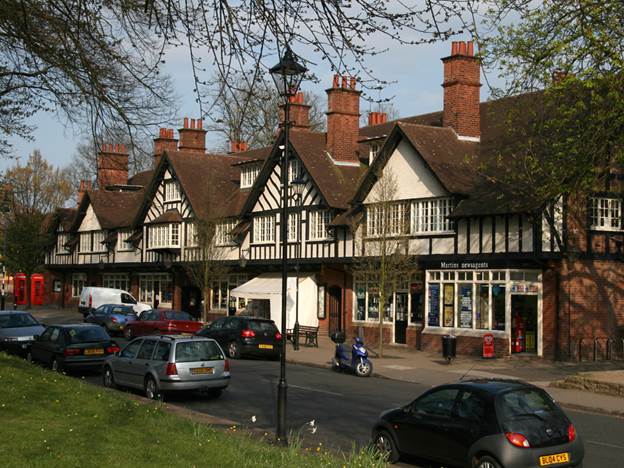
Photo: GavinWarrins
Tony Garnier and Rational Industrial Urbanism
Tony Garnier’s Cité Industrielle proposed zoning industrial, residential and civic functions in ways that minimized conflict and optimized efficiency. While largely theoretical, Garnier’s work reflected a systematic attempt to harmonize industrial production with human living conditions.
Françoise Choay (1969) describes such projects as part of “prophetic urbanism” — normative and systematic urban visions that sought to reshape society through spatial logic. Garnier anticipated later modernist planning but retained a social orientation often diluted in later technocratic interpretations.
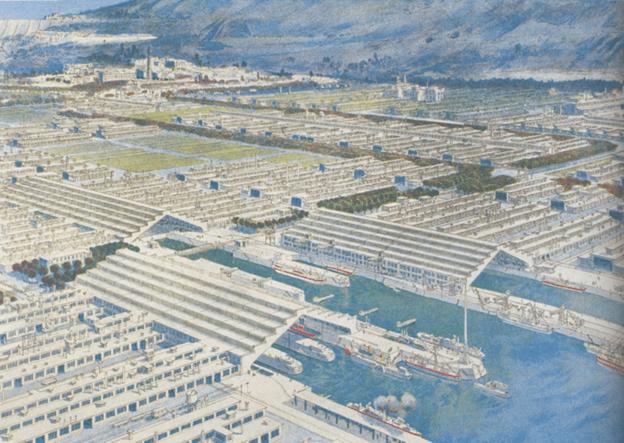
(Photo: Gilles Bernasconi, Archives Municipales de Lyon)
His drawings reveal a conviction: order in space could produce order in society.
From Normative Vision to Technocratic Management
The shift from utopian ambition to regulatory pragmatism occurred gradually in the twentieth century. Planning professionalized, becoming data-driven and bureaucratically structured. While this improved technical precision, it narrowed moral scope.
Jane Jacobs (1961) later critiqued top-down planning, arguing that vibrant cities emerge from social complexity and lived experience. Yet even Jacobs retained utopian energy — her advocacy for mixed-use vitality was deeply normative.
Today, however, planning often prioritizes:
- Quantifiable service delivery over experiential quality
- Infrastructure expansion over social cohesion
- Real estate value over human flourishing
Why Utopian Thinking Matters Today
Contemporary urban crises — climate instability, public health vulnerabilities, loneliness, spatial inequality — cannot be addressed through incremental regulation alone.
Evidence shows:
- Walkable environments increase social capital (Leyden, 2003).
- Built form influences mental health outcomes (Evans, 2003).
- Access to restorative landscapes reduces stress (Ulrich, 1984).
These empirical findings reinforce what utopian planners intuited: urban form is a determinant of wellbeing.
The challenge is not to replicate nineteenth-century model villages, but to recover their normative ambition — to design cities intentionally for dignity, health and community.
Toward a Research-Informed Utopianism
Urban Frontiers Insights has consistently emphasized the intersection of built environment and wellbeing. Re-engaging utopian thinking does not mean abandoning evidence; it means aligning empirical research with moral purpose.
A research-informed utopianism would:
- Embed public health metrics into master planning frameworks.
- Prioritize social cohesion as a planning objective.
- Design neighbourhoods for behavioural outcomes, not only service coverage.
- Integrate long-term wellbeing indicators into infrastructure investments.
This is not romanticism. It is strategic foresight.
Conclusion: Rediscovering Moral Imagination
Owen, Cadbury and Garnier remind us that planning once carried ethical ambition. Their settlements were imperfect, yet they were courageous attempts to reimagine the relationship between space and society.
Contemporary planning possesses advanced data, modelling tools and interdisciplinary research. What it risks lacking is normative clarity.
The future of urbanism lies not in abandoning utopia, but in redefining it — grounding aspiration in research, aligning design with wellbeing, and restoring the planner’s role as both technician and moral agent.
The question is no longer whether utopia is possible.
The question is whether planning can afford to function without it.
References
Choay, F. (1969). The Modern City: Planning in the 19th Century.
Evans, G. W. (2003). The built environment and mental health. Journal of Urban Health, 80(4), 536–555.
Hall, P. (1996). Cities of Tomorrow. Blackwell.
Howard, E. (1898). Garden Cities of To-morrow.
Jacobs, J. (1961). The Death and Life of Great American Cities.
Kaplan, R., & Kaplan, S. (1989). The Experience of Nature. Cambridge University Press.
Leyden, K. M. (2003). Social capital and the built environment. American Journal of Public Health, 93(9), 1546–1551.
Ulrich, R. S. (1984). View through a window may influence recovery from surgery. Science, 224(4647), 420–421.
Cover Photo: mrpbps – New Lanark & River