
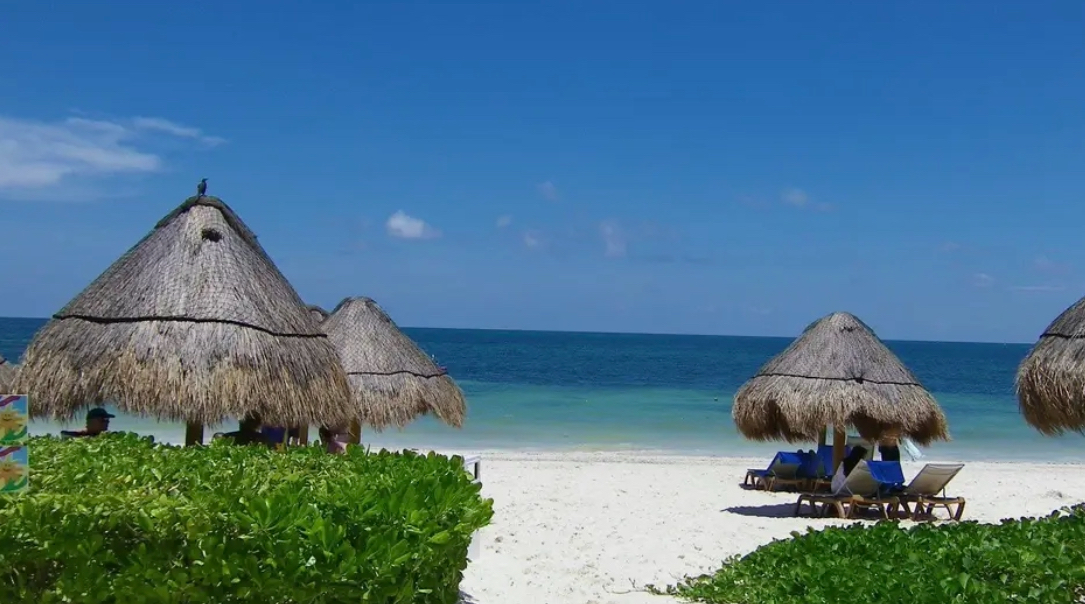
I bought a rosary. But I should have bought two then. It held up so well and was made of beautiful and colourful stones. I looked around and the sun was another sun, a poet’s sun, for it was more mystical and magical. Shallow was the water in that area, clean, and warm, and you could walk for miles. Friendly people, the locals, the expatriates (of which if I could, would also be one in a second given the opportunity), and even the tourists. I looked around. I sat sometimes and read. And I’d make little notes in my journal, titles of prose poems to be written in the future…sometimes several pages of titles. Why not? A poem about the parapet, the palm tree, and one about the marketplace and the sea, and what about how morning is or dusk and the night? All that’s left is the rosary and the memory, so I’d better write at least a bit about it now and again.
The landscape inland had a few things I noticed especially, things to do with how land was used as opposed to where I lived and some other places I’d seen. It had a lot to do with trees but there was more. I had asked someone in the know, supposedly, why they had to cut down all the trees when making a development. This was in Southern Ontario, Canada. I was told that to make the housing and feed the electrical, the water, and other things, it just had to be. They planted a few token trees on boulevards after but that was it. But in high school geography they had taught us about three types of making room on land and these were patch cutting, cross cutting, and clear cutting, with clear cutting being the most unconscious and the worst for the environment of course. Now they were saying everything had to be only clear cut.
Yet I was able in Mexico amidst all kinds of courtyards and establishments that had several beautiful trees. So, they had found a way to go around them and preserve them, and/or took the time to plant and really nurture them in many places besides a few token spots, and they grew. Whatever the case, it wasn’t just that, because there were different types of architecture. In fact, each building was positioned differently and had shapes and forms, plus materials that were inspiring and relaxing to look at and be amongst.
Where I had be seeing in my surrounding communities’ endless big plain grey houses with no personality or colour, I was then seeing a perfect mix of greenery, wood, glass, and stone. So, it can be done. And is done. I believe that the sea and sun, coupled with careful design and planning, can infuse soul, poetic soul, into the atmosphere of public and private areas. It just takes more care and vision, a more wholistic view of nature and engineering and how they can cohabitate.
~~~~~

Brian Michael Barbeito is a Canadian poet, writer, and photographer. His latest work, The Book of Love and Mourning, is his third compilation of prose poems and pictures.