
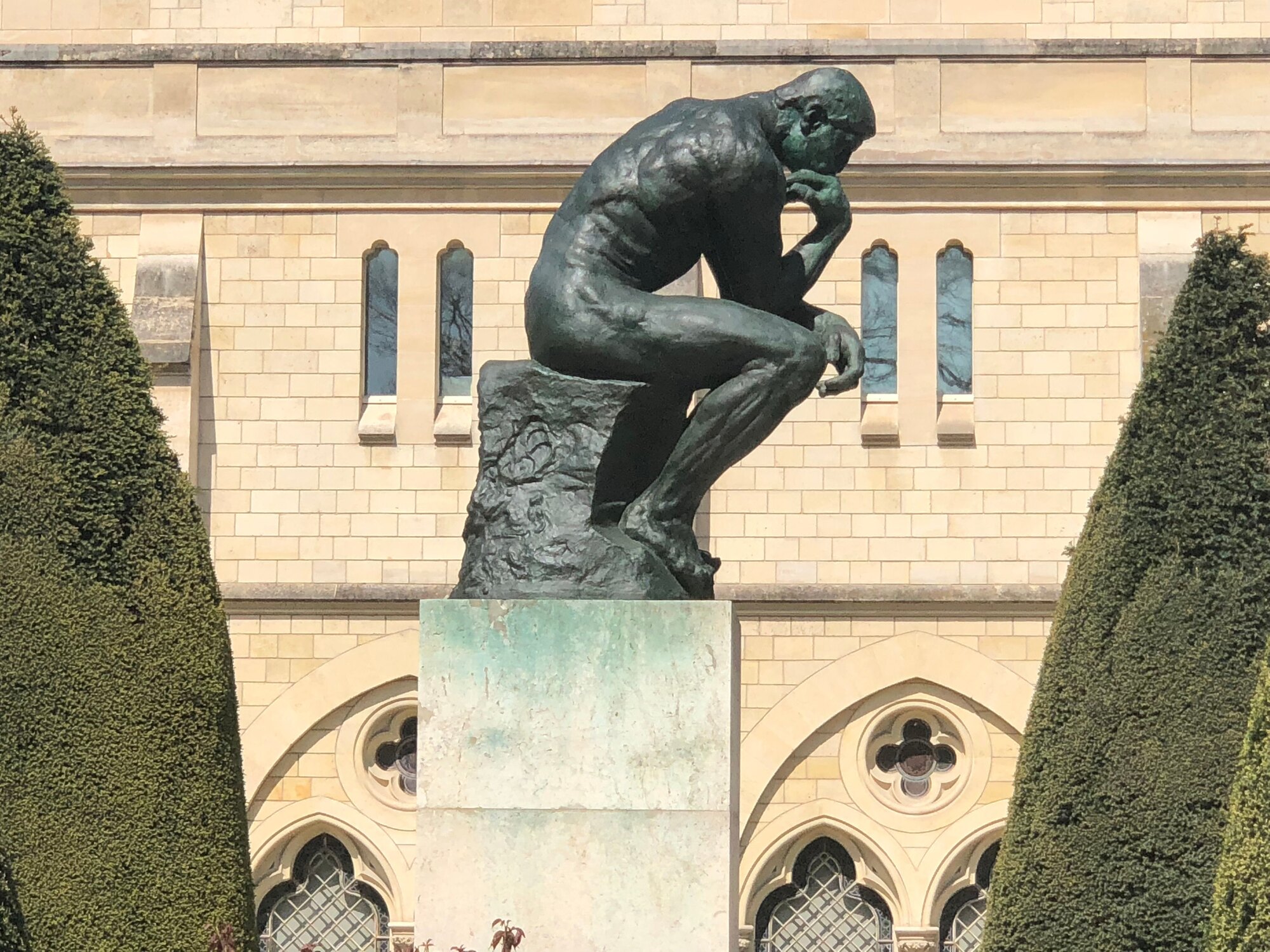
Photo: Auguste Rodin’s The Thinker. Credit: Alexandre Peregrino via Pexels.
Nearly half of humanity now lives in cities. We have become very good at counting them, ranking them and building them. We have become much worse at asking what they are for. Engineers lay the pipes, planners zone the land, architects shape the buildings and economists measure the output. Somewhere between their desks, an older question has gone missing: what kind of life is a city supposed to make possible? Until someone is responsible for that question, the rising tide of stress, loneliness and psychological distress in our cities will keep being treated as a private problem, when it is at least partly a problem of design.
We have learned to count cities, not to ask what they are for
The United Nations reported in 2025 that 45 per cent of the world’s 8.2 billion people live in cities, up from 20 per cent in 1950. There are now 33 megacities of more than ten million people, up from eight in 1975, and Jakarta, with nearly 42 million, is the largest. [1]
Our vocabulary for these places is almost entirely quantitative. A settlement becomes a town at 5,000 inhabitants and a megacity at ten million. National censuses sort towns into classes by population, and investors rank cities by growth and land value. None of these categories is wrong. But each describes how big a place is, not what it is for.
The first philosophers of the city started from the opposite end. Aristotle wrote that the city comes into existence “originating in the bare needs of life”, and continues “for the sake of a good life”. [2] The modern city has become extraordinarily good at the first half of that sentence: water, power, transport, shelter, jobs. It has largely stopped asking about the second half, because no profession has been asked to own it.
Every profession asks “how”, nobody asks “for what”
Look at who sits around the table when a city is planned. The transport engineer asks how many vehicles a road can carry per hour. The planner asks how much floor area a plot may hold. The developer asks how quickly the units will sell, and the finance ministry asks what the project will add to output. Each is a good question, and each is answered by a capable professional.
What none of them is paid to ask is whether the resulting street will let a child play, an old man sit, or a tired worker come home and feel at rest. Those questions are treated as soft, subjective or somebody else’s job, and so they become nobody’s job. The city is shaped by the sum of many “how” questions, and the “for what” question is settled by default: by whatever is fastest, most profitable or easiest to measure.
Plato’s famous line that cities will have no rest from their troubles “until philosophers are kings” is usually read as a call for rule by the learned. [3] It is better read as a warning about separation. He goes on to say that political greatness and wisdom must “meet in one”. In today’s cities they rarely meet. Power sits with those who build; reflection sits in universities, far from the drawing board.
The metropolis and the mind
More than a century ago, the German philosopher Georg Simmel described what the big city does to the inner life. He wrote of “the intensification of emotional life” produced by the constant shift of stimuli, and he described the metropolis as “the peculiar seat of the blasé attitude”: a protective indifference in which people stop noticing the differences between things, and between each other. [4]

Simmel was writing an essay, not a clinical study. Today we have the data he lacked. A meta-analysis of 20 population surveys in developed countries found that city dwellers had 38 per cent higher odds of psychiatric disorder overall and 39 per cent higher odds of mood disorders than rural residents, with smaller but still significant differences after adjustment for other factors. [5] Brain-imaging research published in Nature found that the amygdala, a region central to the processing of threat, was more active under social stress in people who lived in cities, and that a regulatory region of the brain responded differently in those who had grown up in them. [6]
These findings are associations, not proof that the city itself causes illness. Poverty, migration, insecurity and isolation travel with urban life, and they matter as much as density. But the scale of the problem is not in doubt. The World Health Organization estimated that nearly a billion people were living with a mental disorder in 2019, including 14 per cent of the world’s adolescents, and that depression and anxiety rose by more than 25 per cent in the first year of the COVID-19 pandemic alone. [7] A large share of these people live in cities that were never designed with their minds in view.
Speed and the lost self
If Simmel diagnosed the overstimulated city, contemporary philosophers have diagnosed the accelerated one. The German social theorist Hartmut Rosa describes modern life as subject to three kinds of acceleration at once: of technology, of social change and of the pace of life itself. [8] His central paradox is familiar to anyone who commutes in a large city: we save more time than any generation before us, and yet we feel we have none.
The Korean-German philosopher Byung-Chul Han goes further. In The Burnout Society, he argues that the characteristic illnesses of our age are no longer infections but psychological disorders, ranging from depression to attention deficit disorder to borderline personality disorder, produced by an age of “excessive positivity” in which people exhaust themselves trying to optimise every hour. [9]
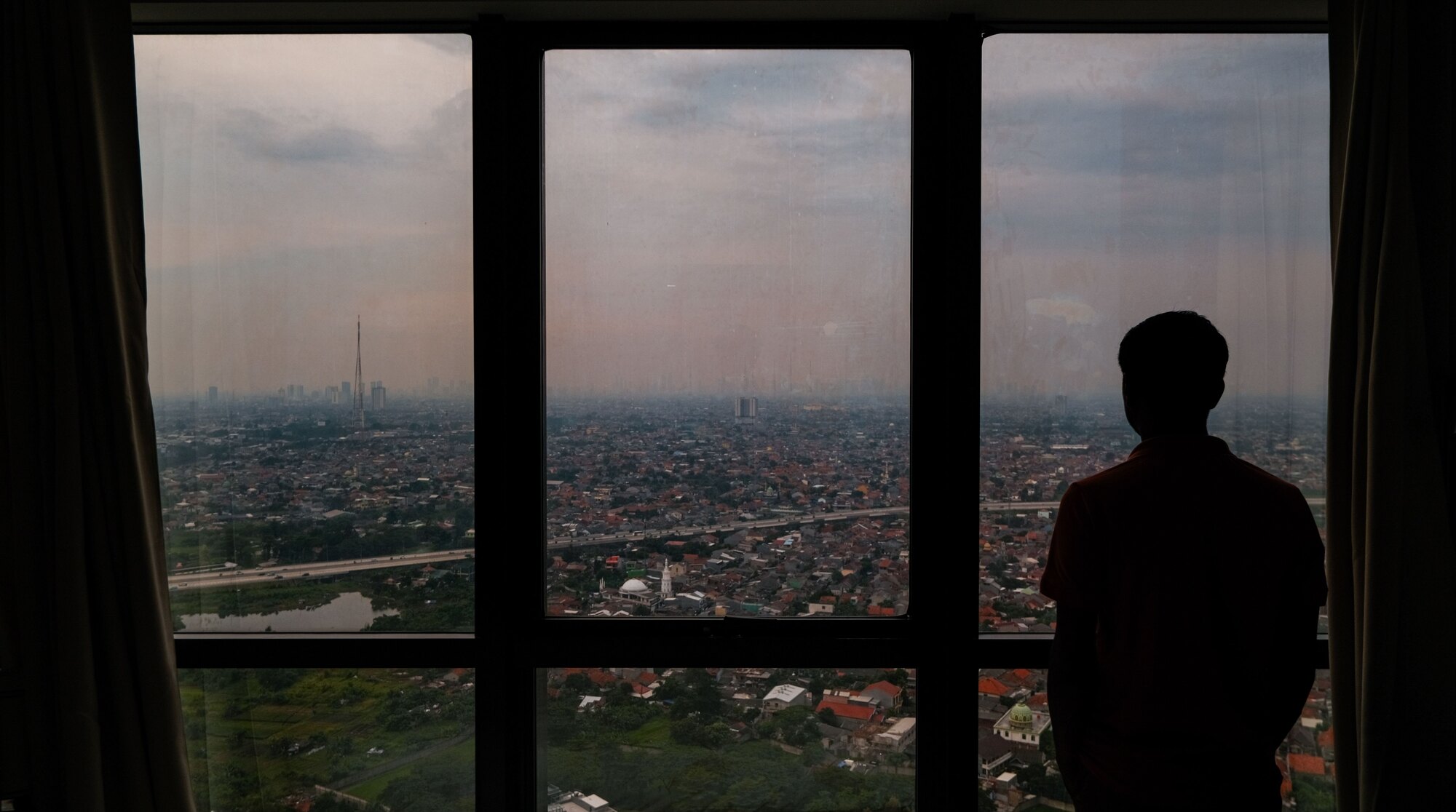
Self-realisation, the slow work of coming to know who one is and what one values, needs time, silence and unhurried relationships. The contemporary city is rarely designed to supply any of the three. It sells speed: faster commutes, faster delivery, faster turnover of shops and neighbours. Very few city plans contain a single line about stillness, contemplation or the inner life. This is not because planners are careless. It is because no one asked a philosopher to write that line.
When a philosopher ran a city
There is at least one modern case of what happens when the “for what” question is put at the centre. Antanas Mockus, a mathematician and philosopher and a former head of the National University of Colombia, served two terms as mayor of Bogotá between 1995 and 2003. [10] He treated the city less as a machine to be engineered than as a culture to be persuaded.
His administration hired mimes to stand at junctions and gently mock drivers and pedestrians who broke traffic rules, on the idea that people fear ridicule more than fines. During a water shortage he appealed to citizens directly, and water use fell by 14 per cent in two months; by the end of his second term it was 40 per cent lower than before the shortage. Over the decade to 2003, the homicide rate fell from about 80 to 22 per 100,000 inhabitants, and traffic deaths fell from an average of about 1,300 a year to about 600. [10][11] Explaining why such efforts were worth it, Mockus said:
Saving a single life justifies the effort.
Many factors drove those numbers, including policing, investment and the policies of his successors. But Bogotá’s experiment shows something planners rarely try: changing how people see each other, not only where they move.
Where philosophy came first
Other places have begun from an idea of the good life rather than from a land-use plan.
In 1901 the poet and philosopher Rabindranath Tagore founded Santiniketan in rural Bengal, combining education, nature, music and the arts, with classes held in the open air under trees. UNESCO, which now lists it as a World Heritage Site, describes it as built on “a vision of the unity of humanity transcending religious and cultural boundaries”. In 1921 Tagore established Visva-Bharati there, a world university. [12] Santiniketan is small, but it remains a rare example of a place laid out to serve a philosophy of the person.
In Wales, the Well-being of Future Generations Act 2015 writes a philosophical question into law. Public bodies, including local authorities and health boards, must work towards seven well-being goals, among them a healthier Wales and a Wales of cohesive communities, and must act according to five ways of working: thinking long-term, integrating, involving people, collaborating and preventing harm. A Future Generations Commissioner monitors their progress. [13] The Act does not make philosophers into planners, but it obliges planners to answer a philosopher’s question.
What a philosopher would bring to the planning table
Putting philosophy back into city-making does not mean handing cities to academics. It means making five habits routine.
Ask “for what?” before “how much?”. Every major project should begin with a written statement of the kind of life it is meant to support, in plain language, before any floor-area or traffic calculation is made.
Measure flourishing, not only throughput. Cities track vehicle speeds, land values and tax receipts in detail. They should track loneliness, sense of meaning, time spent in nature and psychological distress with the same seriousness, and publish the results.
Protect time and stillness. Quiet public rooms, unhurried streets, green spaces within a short walk and limits on the endless extension of commuting time should be treated as infrastructure, not luxuries.
Design for encounter and meaning. Streets, squares, libraries, temples, gardens and meeting halls where people of different backgrounds share time without having to buy anything are where the blasé attitude is undone.
Bring the humanities into planning. Planning and architecture schools should teach ethics and philosophy alongside engineering. City boards and master-plan committees should include philosophers, psychologists and citizens’ assemblies, with a real voice and not a token seat.
An honest position
Philosophers alone cannot fix psychological distress. People also need housing, income, safety and access to good mental health care, and no amount of reflection replaces them. Nor is it true that philosophy has been entirely absent from cities: Mockus, Tagore and the authors of the Welsh Act show that it can still shape places when it is invited in.
But the default has changed. Our cities are shaped mainly by those who answer “how” questions, and the “for what” question is settled by speed and profit. The rising tide of stress, anxiety, loneliness and burnout is, in part, the cost of that silence. Aristotle’s distinction still stands. A city that meets only the bare needs of life has done half its job. The other half, the good life, will not plan itself. Someone has to be asked to think about it, and to be heard when they do.
Connect with the author, Asesh Sarkar, on LinkedIn, and follow Urban Frontier Insights on LinkedIn.
References
[1] United Nations (2025). Cities now home to nearly half of humanity: UN report. UN News, 18 November 2025. https://news.un.org/en/story/2025/11/1166395
[2] Aristotle. Politics, Book I, Part II. Trans. B. Jowett. MIT Internet Classics Archive. http://classics.mit.edu/Aristotle/politics.1.one.html
[3] Plato. The Republic, Book V. Trans. B. Jowett. MIT Internet Classics Archive. http://classics.mit.edu/Plato/republic.6.v.html
[4] Simmel, G. (1903). The Metropolis and Mental Life. Trans. D. N. Levine, in On Individuality and Social Forms, University of Chicago Press, 1971. German History in Documents and Images. https://germanhistorydocs.org/en/wilhelmine-germany-and-the-first-world-war-1890-1918/georg-simmel-the-metropolis-and-mental-life-1903
[5] Peen, J., Schoevers, R. A., Beekman, A. T., & Dekker, J. (2010). The current status of urban–rural differences in psychiatric disorders. Acta Psychiatrica Scandinavica, 121(2), 84–93. https://doi.org/10.1111/j.1600-0447.2009.01438.x
[6] Lederbogen, F., Kirsch, P., Haddad, L., et al. (2011). City living and urban upbringing affect neural social stress processing in humans. Nature, 474(7352), 498–501. https://doi.org/10.1038/nature10190
[7] World Health Organization / PAHO (2022). WHO highlights urgent need to transform mental health and mental health care. 17 June 2022. https://www.paho.org/en/news/17-6-2022-who-highlights-urgent-need-transform-mental-health-and-mental-health-care
[8] Rosa, H. (2013). Social Acceleration: A New Theory of Modernity. Columbia University Press. https://doi.org/10.7312/rosa14834
[9] Han, B.-C. (2015). The Burnout Society. Stanford University Press (Stanford Briefs). https://www.sup.org/books/title/?id=25725
[10] Caballero, M. C. (2004). Academic turns city into a social experiment. Harvard Gazette, 11 March 2004. https://news.harvard.edu/gazette/story/2004/03/academic-turns-city-into-a-social-experiment/
[11] Mockus, A. (2012). Building “Citizenship Culture” in Bogotá. Journal of International Affairs, Columbia SIPA, 18 April 2012. https://jia.sipa.columbia.edu/news/building-citizenship-culture-bogota
[12] UNESCO World Heritage Centre. Santiniketan. https://whc.unesco.org/en/list/1375
[13] Future Generations Commissioner for Wales. Well-being of Future Generations (Wales) Act 2015. https://www.futuregenerations.wales/about-us/future-generations-act/
Write for UFI
Have a story about cities? We publish articles and photo essays from researchers, practitioners and photographers.
Pitch us at contact@urbanfrontierinsights.com