
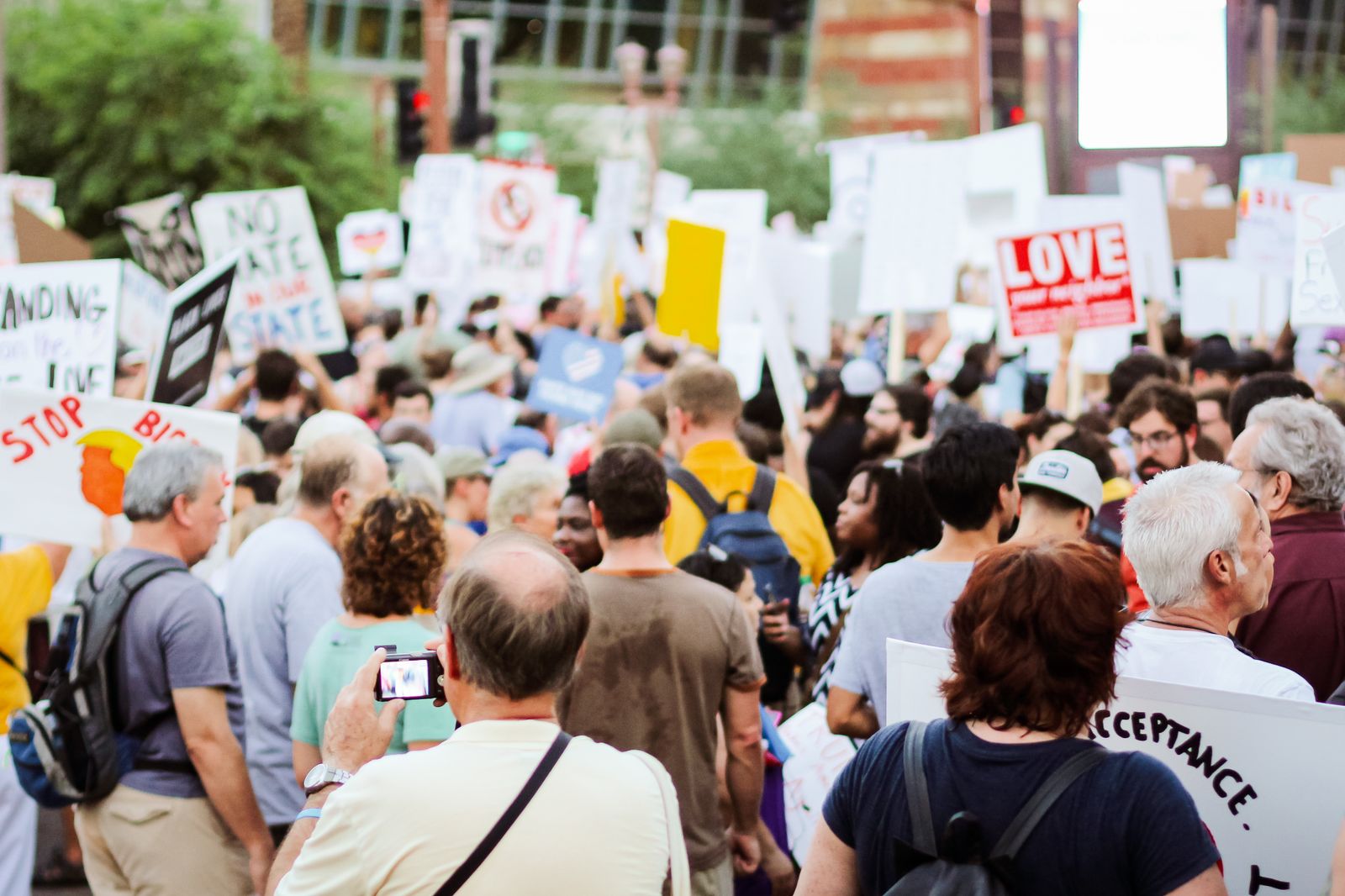
In 2025 corruption, government overreach and economic hardship drove large anti-government protests around the world [1]. Young people led many of them, from Nepal and Indonesia to Peru, Morocco and Madagascar, while protests in Serbia that began after a station roof collapse in Novi Sad continued almost daily for more than a year [1]. Their causes differed. Their first practical need was the same: somewhere to stand.
Protest is a claim made in space. A demonstration needs a street to march along, a square to fill, a park in which to stay. That makes the design, ownership and management of public space a question of governance, not just of urban form. This article looks at how cities and states have handled that question, what international standards ask of them, and how planners can make room for dissent without ignoring the needs of everyone else who uses the city.
Public space as democratic infrastructure
Urban theorists have long argued that rights need ground to stand on. The geographer Don Mitchell, building on Henri Lefebvre’s idea of the right to the city, argued that public space is not simply given by planners: it is produced and kept public through use, including the use of protest [2]. The political theorist John Parkinson made a related point from democratic theory. Even in a digital age, democracy depends on physical sites where claims are made visible to fellow citizens and to those in power [3].
International law now says something similar. In July 2020 the UN Human Rights Committee adopted General Comment No. 37, its first full interpretation of the right of peaceful assembly under Article 21 of the International Covenant on Civil and Political Rights [4]. It holds that restrictions must be grounded in law and be necessary and proportionate to aims such as public order, public health or the rights of others [5]. It also recognises that people may take part anonymously, and it addresses surveillance at assemblies, including facial recognition [6].
None of this makes the right unlimited. Streets are also needed by ambulances, shopkeepers, commuters and residents who did not choose to join a protest. The governance question is not whether to balance these interests but who does the balancing, on what evidence, and with what accountability.
Four places, four lessons
Gezi Park, Istanbul (2013): when a planning decision becomes a national crisis. A small campaign to stop the redevelopment of Gezi Park, one of the few green spaces in central Istanbul, into a replica Ottoman barracks grew into nationwide anti-government protests that drew an estimated three million people [7]. A court later struck down approval for the project because there had been no adequate public consultation [7], although the country’s top administrative court reversed its own block in 2015 [8]. Eight people died and thousands were injured, and demonstrations in neighbouring Taksim Square have since been banned [8]. A routine planning decision, taken without residents, became one of the defining political crises of the decade.
Zuccotti Park, New York (2011): when public space is privately owned. Occupy Wall Street began in Zuccotti Park, a privately owned public space created through a zoning bonus. After the occupation started, the owner issued new rules, and the court noted that it had not previously published any [9]. When police cleared the camp on 15 November 2011, a judge held that the protesters had not shown a First Amendment right to stay with tents and structures to the exclusion of the owner’s rights and other people’s access [10]. The case left open a lasting question: how public is a space that a private company manages?
Shaheen Bagh, Delhi (2019–2020): when a road becomes the site. Protesters against India’s Citizenship Amendment Act occupied a stretch of road for months. In October 2020 the Supreme Court affirmed that dissent and democracy go together, but held that public ways cannot be occupied indefinitely and that the authorities, not the courts, must act to keep them clear [11]. Critics, including senior lawyers, argued that the ruling set the bar for restricting protest too low, since inconvenience to traffic is not the same as a threat to public order, and that alternative roads could have been opened [12].
The United Kingdom (2023): when the law moves first. Citing disruption by climate groups, the UK government passed the Public Order Act 2023, which created an offence of “locking on”, widened stop-and-search powers to prevent disruptive protest and introduced orders that can bar individuals from protests [13, 14]. The Welsh Government, Amnesty International, Liberty and others criticised the powers as eroding peaceful protest, and the Metropolitan Police admitted wrongly arresting six demonstrators around the King’s Coronation, days after the law came into force [13].
| Case | Space | Who decided | Outcome | Lesson |
|---|---|---|---|---|
| Gezi Park, Istanbul (2013) | Public park | National and city government | Mass protest; project blocked for lack of consultation, later revived | Consult before transforming symbolic public space |
| Zuccotti Park, New York (2011) | Privately owned public space | Private owner, police, courts | Camp cleared; owner’s rules upheld | Ownership shapes the right to assemble |
| Shaheen Bagh, Delhi (2019–2020) | Public road | Courts, after police inaction | Indefinite occupation ruled out | Plan for disruption before courts are asked to |
| United Kingdom (2023) | All public space | National legislature | New offences and police powers | Broad laws reach far beyond the protests that prompted them |
Two quieter pressures
The cases above made headlines. Two slower trends may matter more for the long-term health of public space.
More public space is privately managed. Plazas delivered through planning bonuses, shopping streets run by business districts and the forecourts of new developments look public but often carry private rules. Zuccotti showed how quickly those rules can change once a space becomes politically inconvenient [9]. Every new privately managed plaza is a quiet decision about where assembly will and will not be possible.
Surveillance changes who feels able to attend. General Comment No. 37 treats anonymity as part of the right to assemble and warns about surveillance technologies, including facial recognition [6]. The European Union has gone furthest in law: the AI Act bans real-time remote biometric identification by police in publicly accessible spaces except in narrowly defined cases, which require a fundamental rights impact assessment and registration of the system [15]. A square that is open but fully watched is not equally open to everyone (see our earlier piece, Who Answers for the Agent?).
Making room for dissent: six recommendations
1. Treat assembly as a design requirement. Major squares, civic plazas and boulevards should be planned to hold large gatherings safely, with space for crowds, exits, shade, water and toilets. Designated spaces help, but they should never become the only places where protest is allowed.
2. Write public rights into privately managed space. When a developer receives a planning bonus for a plaza, the agreement should state that the public may gather and express views there on the same terms as in a public park, and that rules cannot be changed without notice and review [9].
3. Consult before transforming symbolic spaces. Gezi shows the cost of redeveloping a much-loved public space without residents [7]. Major changes to central squares and parks deserve open consultation, published options and time.
4. Plan for disruption before it happens. Transport diversions, alternative routes and agreed contact points between organisers and authorities can reduce the conflict between protesters and other users, and keep disputes from landing in court first [12].
5. Limit surveillance at assemblies. Follow the direction of General Comment No. 37 and the EU AI Act: no live facial recognition of crowds except under narrow, lawful and reviewed conditions, with published records of each use [6, 15].
6. Publish how protest is governed. Cities and police forces should report how many assemblies were notified, restricted, dispersed or banned, and why, so that the proportionality test in General Comment No. 37 can be checked against practice [5].
Cities will always have to balance the right to protest with the right to move, trade and rest. That balance is legitimate. The danger lies in letting it be struck by default: by a privately written rulebook, by an unconsulted redevelopment, by a camera network nobody voted for. Planners shape where democracy can happen. They should do so deliberately and in the open.
References
1. Carnegie Endowment for International Peace. (2025, December). Corruption, overreach, and hardship: The global drivers of protests in 2025. Carnegie Emissary. carnegieendowment.org
2. Mitchell, D. (2003). The right to the city: Social justice and the fight for public space. Guilford Press.
3. Parkinson, J. R. (2012). Democracy and public space: The physical sites of democratic performance. Oxford University Press.
4. UN Human Rights Committee. (2020). General comment No. 37 (2020) on the right of peaceful assembly (article 21) (CCPR/C/GC/37). Via International Center for Not-for-Profit Law. icnl.org
5. American Society of International Law. (2020). Protests surge globally: UN Human Rights Committee provides timely guidance. ASIL Insights, 24(29). asil.org
6. ARTICLE 19. (2020). HR Committee: ARTICLE 19 welcomes General Comment no. 37 on the right of peaceful assembly. article19.org
7. Al Jazeera. (2014, 19 November). Turkey to go ahead with Istanbul park plan. Al Jazeera. aljazeera.com
8. AFP. (2016, 19 June). Erdogan vows to forge ahead with contested Gezi Park project. Ahram Online. english.ahram.org.eg
9. Matter of Waller v City of New York, 34 Misc 3d 371 (N.Y. Sup. Ct. 2011). nycourts.gov
10. Associated Press. (2011, 15 November). Occupy movement’s future unclear after NYC sweep. MPR News. mprnews.org
11. Global Freedom of Expression, Columbia University. (n.d.). Amit Sahni v. Commissioner of Police [Case analysis, Supreme Court of India, 7 October 2020]. globalfreedomofexpression.columbia.edu
12. The Quint. (2020, October). Prashant Bhushan, Karuna Nundy explain how the Shaheen Bagh judgment contradicts a prior verdict and international law. The Quint. thequint.com
13. Welsh Government. (2023). Statement on the Public Order Act 2023. gov.wales
14. Exchange Chambers. (2023, May). The Public Order Act 2023 [Briefing]. exchangechambers.co.uk
15. European Commission. (n.d.). Article 5: Prohibited AI practices. AI Act Service Desk. ai-act-service-desk.ec.europa.eu
Cover image: Protesters with placards in a city street. Photo by M Sides on Pexels.
Write for UFI
Have a story about cities? We publish articles and photo essays from researchers, practitioners and photographers.
Pitch us at contact@urbanfrontierinsights.com