
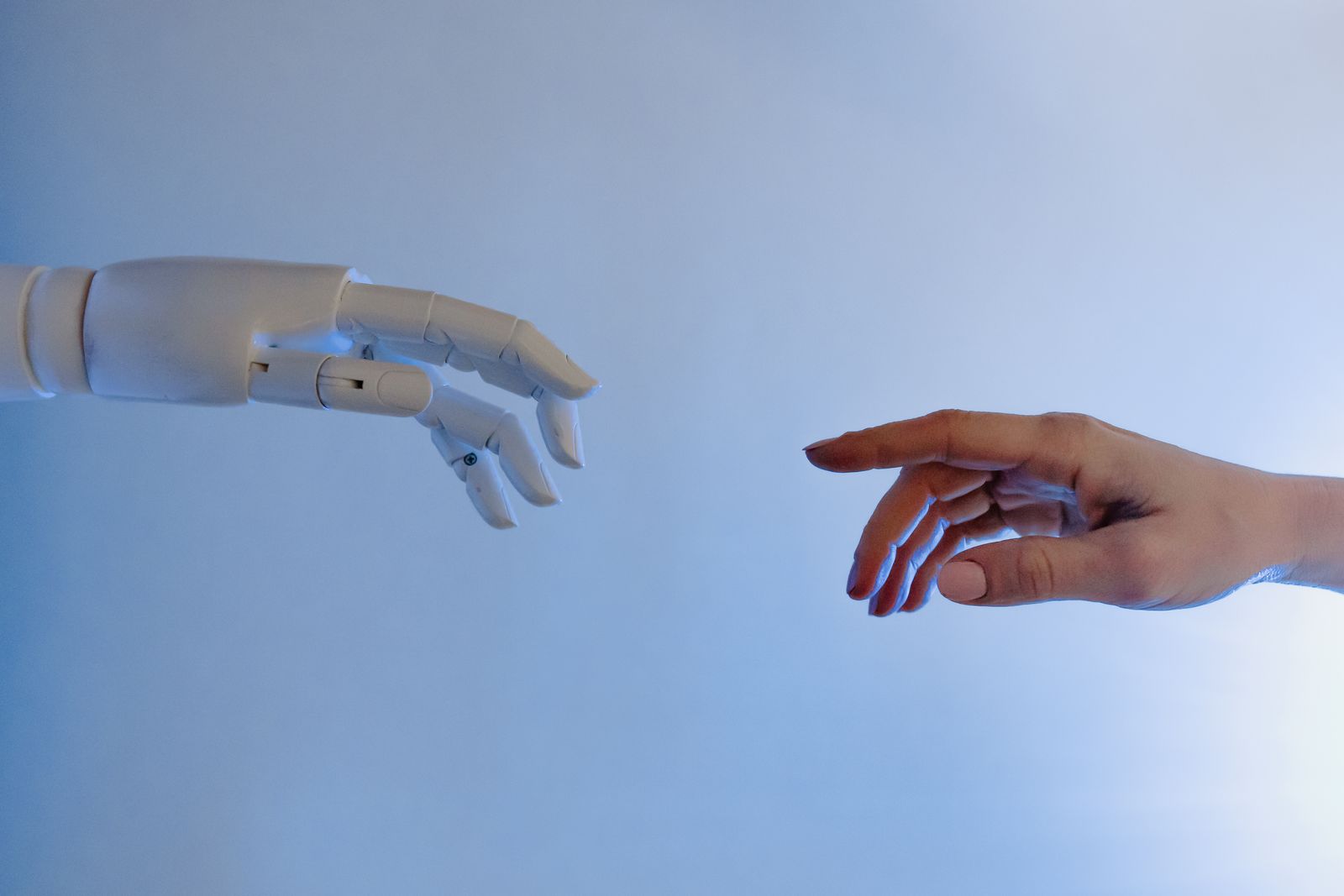
For a century, cinema has rehearsed our future with intelligent machines. In Metropolis (1927) a robot double incites a city to riot. In 2001: A Space Odyssey (1968), HAL calmly refuses to open the pod bay doors. The Terminator (1984) made machine rebellion a blockbuster genre; WALL-E (2008) imagined humans drifting in automated comfort; Her (2013) asked whether we might fall in love with software. Today the robots are leaving the screen. Physical AI — machines that perceive, reason about and act in the physical world — is already driving taxis, sorting parcels and walking factory floors, as we explored in an earlier article. And its most prominent champions promise not dystopia but utopia: a world of abundance where work is optional. Which raises three questions this article tries to answer. Whose dream is this? How would we know if it is the best possible future? And what other futures are on the table?
A century of screen futures
Stories shape what we expect from technology, and what we fear. A review by the Royal Society and the Leverhulme Centre for the Future of Intelligence found that Western fiction tends to portray intelligent machines as hyper-aggressive, in the mould of the Terminator, whereas Japanese popular culture more often casts them as companions, like Doraemon. It warned that framing AI as humanoid, or pushing it to utopian or dystopian extremes, inflates public hopes and fears and can distort research, funding and regulation [1]. The word “utopia” itself carries a warning. Thomas More coined it in 1516 from Greek roots meaning “no place”, with a pun on “good place” [2]. Ursula K. Le Guin sharpened the point in “The Ones Who Walk Away from Omelas” (1973), a story about a perfectly happy city whose joy depends on a single hidden child kept in misery [3]. Every utopia, in other words, should be asked who is out of frame.
The abundance dream
The most influential utopian vision of physical AI today comes from Elon Musk. Tesla’s “Master Plan Part IV”, published in September 2025, sets out a goal of “sustainable abundance” delivered through AI and robotics [4], and Musk has predicted that Optimus humanoid robots will eventually account for around 80% of Tesla’s value [5]. At the VivaTech conference in Paris in 2024, he described a future in which work becomes “optional”, supported by a “universal high income”, adding that “probably none of us will have a job” and that the real question would be one of meaning [6].
The vision has deep roots. In 1930, John Maynard Keynes predicted that his grandchildren’s generation might need to work only fifteen hours a week, and that humanity’s great challenge would become how to use its freedom well [7]. The appeal is obvious: an end to drudgery and danger, cheap goods and services, robots that care for the old and clean up the planet. Many people share parts of this dream. The harder question is whether it should be everyone’s.
Whose dream is it?
A utopia designed by a few companies is likely to reflect their assumptions about what people want. If robots do most of the work, the critical question becomes who owns the robots — and therefore who receives the income they generate. The International Monetary Fund estimates that almost 40% of jobs worldwide, and about 60% in advanced economies, are exposed to AI, and its managing director has warned that “in most scenarios, AI will likely worsen overall inequality” unless policymakers act [8]. A “universal high income” is a political settlement, not a technical feature; nothing in the technology guarantees it.
Priorities also differ. For much of the world, a good future means clean water, secure housing, safe streets, decent work and a voice in local decisions, not a household humanoid. And work is not only income. It gives many people structure, identity and daily contact with others, which is exactly what Musk’s own remark about meaning acknowledges. Finally, the same technologies that promise abundance are transforming war. The 2026 Global Peace Index reports that drone attacks rose by more than 11,500% between 2018 and 2025, and that AI has compressed targeting decisions from about a day to seconds [9]. A future of abundance for some and autonomous conflict for others would not be anyone’s utopia.
How would we know it is the best case?
If we cannot simply trust the visionaries, we need ways to measure what a “best case” looks like. Here, decades of research offer a clear lesson: output is not the same as wellbeing. The Commission on the Measurement of Economic Performance and Social Progress, led by Joseph Stiglitz, Amartya Sen and Jean-Paul Fitoussi, urged governments to shift from measuring production to measuring people’s wellbeing and its sustainability [10]. Richard Easterlin observed as early as 1974 that rising national income did not automatically bring rising happiness [11].
Alternatives exist. Bhutan’s Gross National Happiness Index assesses nine domains, including psychological wellbeing, health, time use, community vitality, cultural resilience, good governance and ecological resilience [12]. Kate Raworth’s “doughnut” defines a safe space between a social foundation that no one should fall below and an ecological ceiling we must not overshoot [13]. The World Happiness Report 2026 again ranks Finland first, for the ninth year running, followed by Iceland, Denmark, Costa Rica and Sweden; India ranks 116th of 147 countries [14]. None of the leaders is the world’s most automated society. What distinguishes them is closer to trust, social support, freedom and good governance.
Wellbeing can also be measured where people actually live. In India, Sarkar and Pujara have developed an urban environment assessment framework for mental well-being through expert consensus [15], and a conceptual framework that links urban environment indicators, from green and public spaces to social infrastructure, to mental well-being [16]. Tools like these allow cities to ask whether a new technology improves daily life, rather than only whether it is deployed.
Drawing these threads together, any proposed “best case” future, including a robot-powered one, could be tested against six questions:
1. Wellbeing: does it improve how people’s lives actually go, not just what they can buy?
2. Fairness: who gains, who loses, and who owns the machines?
3. Planet: does it stay within ecological limits?
4. Agency: do communities have a real say in how it is deployed?
5. Peace: does it make conflict less likely, or easier to wage?
6. Meaning and connection: does it strengthen the relationships and purpose that make life worth living?
Are there alternative worlds?
Yes, and many are older than Silicon Valley. Buen vivir, the Andean idea of “good living” in balance with community and nature, was written into Ecuador’s 2008 constitution and frames development as harmony rather than accumulation [17]. New Zealand’s 2019 Wellbeing Budget organised public spending around priorities such as mental health and child wellbeing rather than growth alone [18]. Gandhian ideas of sufficiency and local self-reliance have long offered India a vocabulary for a good life that does not depend on endless consumption. And solarpunk, a growing current in fiction and design, imagines high-tech futures powered by renewable energy and organised around community, greenery and repair rather than spectacle.
In these worlds, physical AI still has a place, but a different job. Robots could take on care, disaster response, dangerous maintenance and recycling; algorithms could help farmers and city services; and ownership could be public, cooperative or community-based rather than concentrated in a handful of firms. The question shifts from “How much can machines do?” to “What do we want them to do, and for whom?”
Global happiness and peace
Measured honestly, the world is a long way from any utopia. The 2026 Global Peace Index found that 99 countries became less peaceful in the past year, the largest deterioration in the index’s 20-year history, and counted 61 active state-based conflicts, the most since the Second World War. The economic cost of violence reached US$21.81 trillion, about 10.5% of global GDP [9]. Happiness and peace are connected: the societies that report the highest life satisfaction are also among the most trusting and secure. Notably, the World Happiness Report 2026 chose social media and the wellbeing of young people as its theme [14], a reminder that digital technologies can erode wellbeing as easily as they enrich it. A technology that makes some people richer while making the world less safe is not progress by any meaningful measure.
Is Elon’s dream everyone’s dream?
No single dream should be. Musk’s vision of abundance deserves to be taken seriously, and parts of it may well come true. But a good future cannot be declared by its builders; it has to be judged by the people who live in it, against measures they recognise. The best case is unlikely to be one world at all, but many: shaped by local cultures, governed democratically, measured by wellbeing, fairness, ecological limits and peace. The most useful question to ask of any utopia, whether it arrives from Hollywood or from a product launch, is the one Le Guin’s readers learned to ask: better for whom, measured how, and decided by whom?
References
1. Royal Society & Leverhulme Centre for the Future of Intelligence. (2018). Portrayals and Perceptions of AI and Why They Matter. London: The Royal Society. royalsociety.org
2. More, T. (2003 [1516]). Utopia (P. Turner, Trans.). London: Penguin Classics.
3. Le Guin, U. K. (1973). The ones who walk away from Omelas. In R. Silverberg (Ed.), New Dimensions 3. New York: Doubleday.
4. Tesla. (2025). Master Plan Part IV. Austin, TX: Tesla, Inc. tesla.com
5. Muller, J. (2025, September 2). Musk: 80% of Tesla value will be Optimus robots. Axios. axios.com
6. CNN Business. (2024, May 23). Elon Musk says AI will take all our jobs. CNN. cnn.com
7. Keynes, J. M. (1931 [1930]). Economic possibilities for our grandchildren. In Essays in Persuasion. London: Macmillan.
8. Georgieva, K. (2024, January 14). AI will transform the global economy. Let’s make sure it benefits humanity. IMF Blog. International Monetary Fund. Reported in Gulf News.
9. Institute for Economics & Peace. (2026). Global Peace Index 2026. Sydney: IEP. visionofhumanity.org
10. Stiglitz, J. E., Sen, A., & Fitoussi, J.-P. (2009). Report by the Commission on the Measurement of Economic Performance and Social Progress. Paris.
11. Easterlin, R. A. (1974). Does economic growth improve the human lot? Some empirical evidence. In P. A. David & M. W. Reder (Eds.), Nations and Households in Economic Growth (pp. 89–125). New York: Academic Press.
12. Ura, K., Alkire, S., Zangmo, T., & Wangdi, K. (2012). A Short Guide to Gross National Happiness Index. Thimphu: Centre for Bhutan Studies.
13. Raworth, K. (2017). Doughnut Economics: Seven Ways to Think Like a 21st-Century Economist. London: Random House Business.
14. Helliwell, J. F., Layard, R., Sachs, J. D., De Neve, J.-E., Aknin, L. B., & Wang, S. (Eds.). (2026). World Happiness Report 2026. Oxford: Wellbeing Research Centre, University of Oxford. Rankings summarised in Manorama Yearbook.
15. Sarkar, A., & Pujara, T. (2024). Development of an urban environment assessment framework for mental well-being in India using nominal group technique and rank order centroid method. Cities & Health, 9(1), 90–111. doi.org/10.1080/23748834.2024.2436708
16. Sarkar, A., & Pujara, T. (2025). A conceptual framework for mapping urban environment indicators and mental well-being. Discover Cities, 2(1), 119. doi.org/10.1007/s44327-025-00166-z
17. Gudynas, E. (2011). Buen Vivir: Today’s tomorrow. Development, 54(4), 441–447.
18. New Zealand Treasury. (2019). The Wellbeing Budget 2019. Wellington: Government of New Zealand.
Cover image: a human hand reaching towards a robotic hand. Photo by Tara Winstead on Pexels.
Write for UFI
Have a story about cities? We publish articles and photo essays from researchers, practitioners and photographers.
Pitch us at contact@urbanfrontierinsights.com